Google's Online Estimates Filter for HVAC: What We Know in 2026
Jay, InstantEstimateHQ
Last updated: September 2026 · See changelog
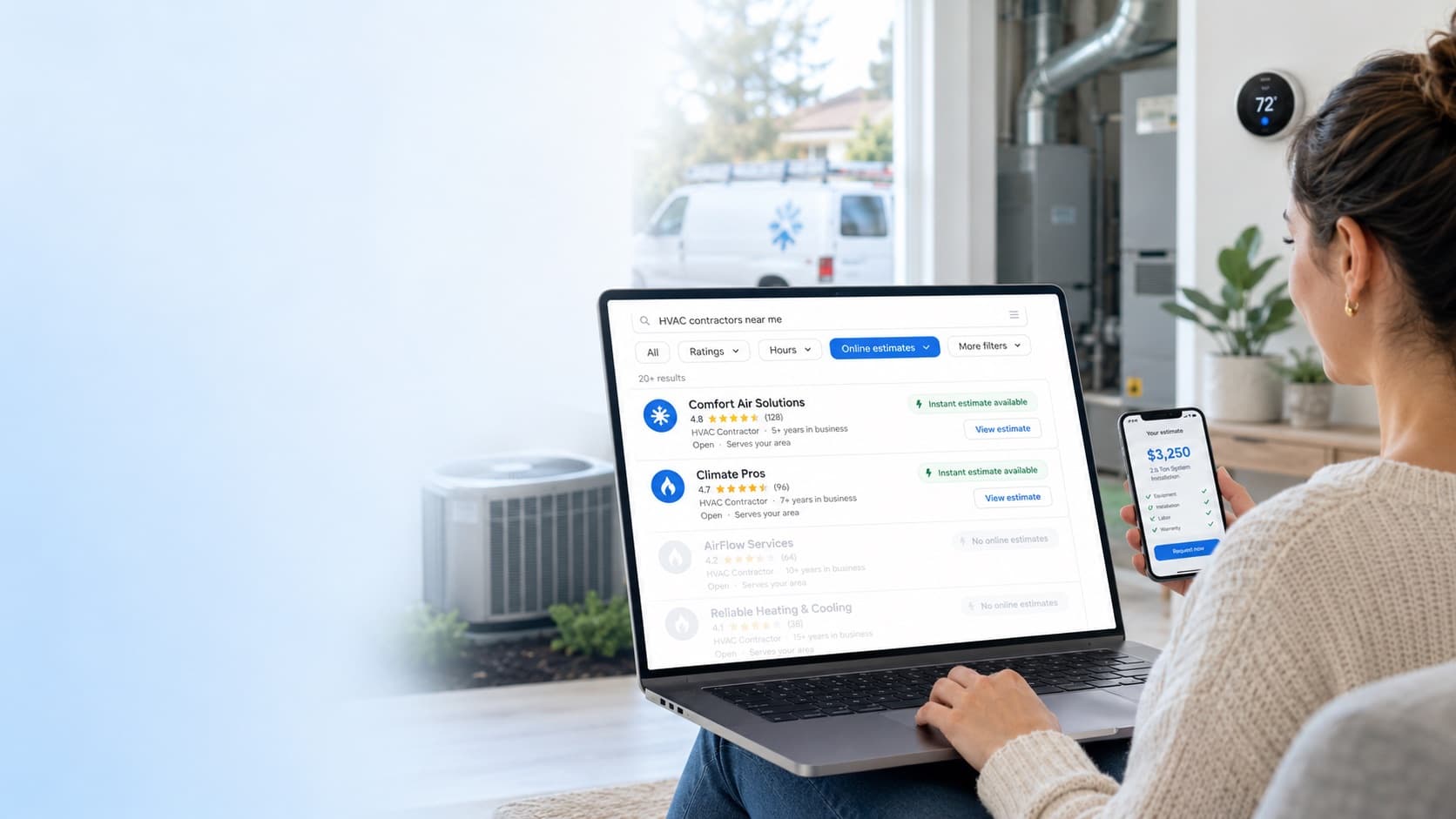
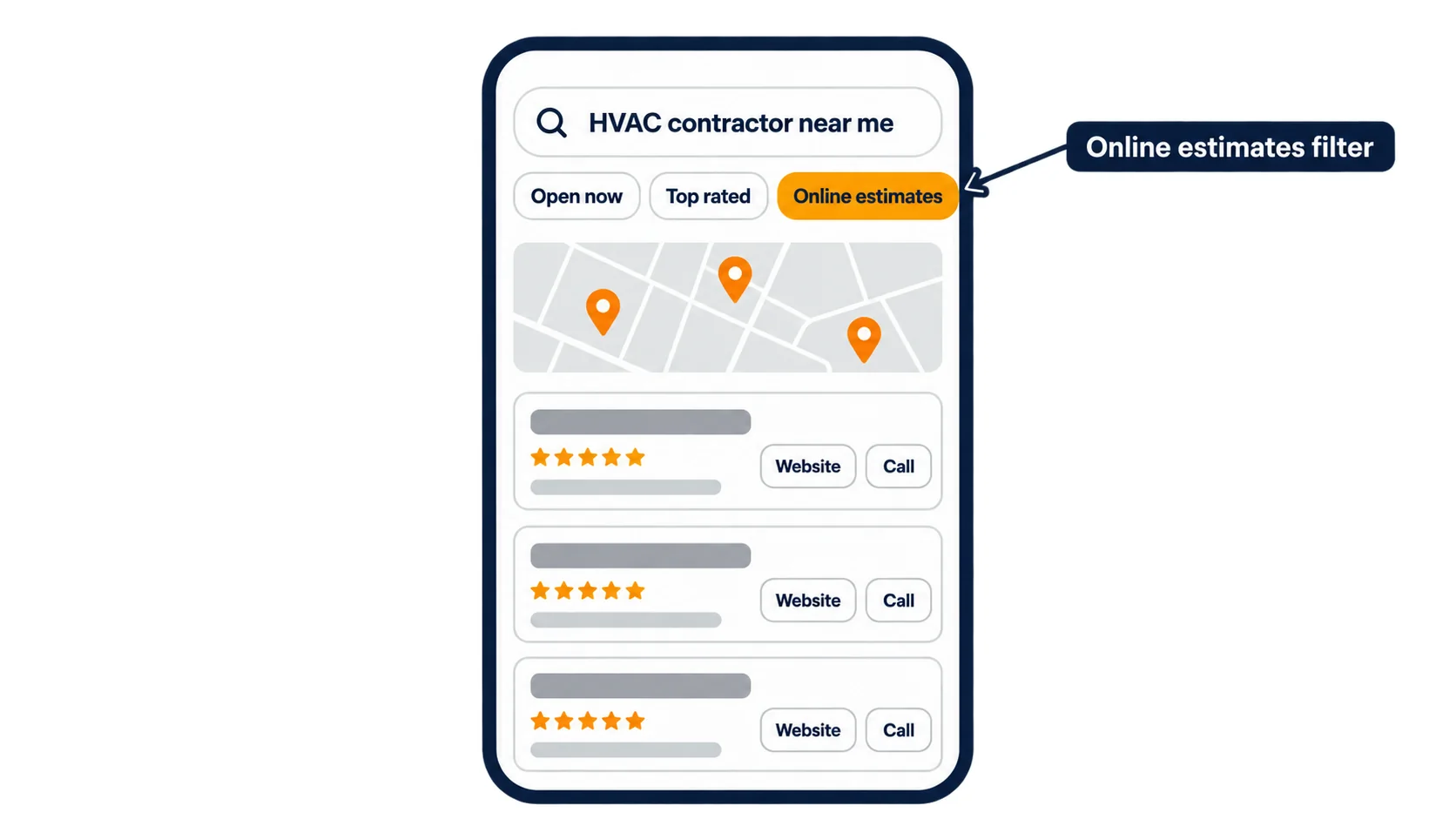
If you run a residential HVAC company, you may have noticed a new option above some local Google results: Online estimates. When a homeowner taps it, Google narrows the list to contractors that appear to offer estimates online.
That raises an obvious question for HVAC owners: if I don't give homeowners pricing online, am I going to disappear from Google?
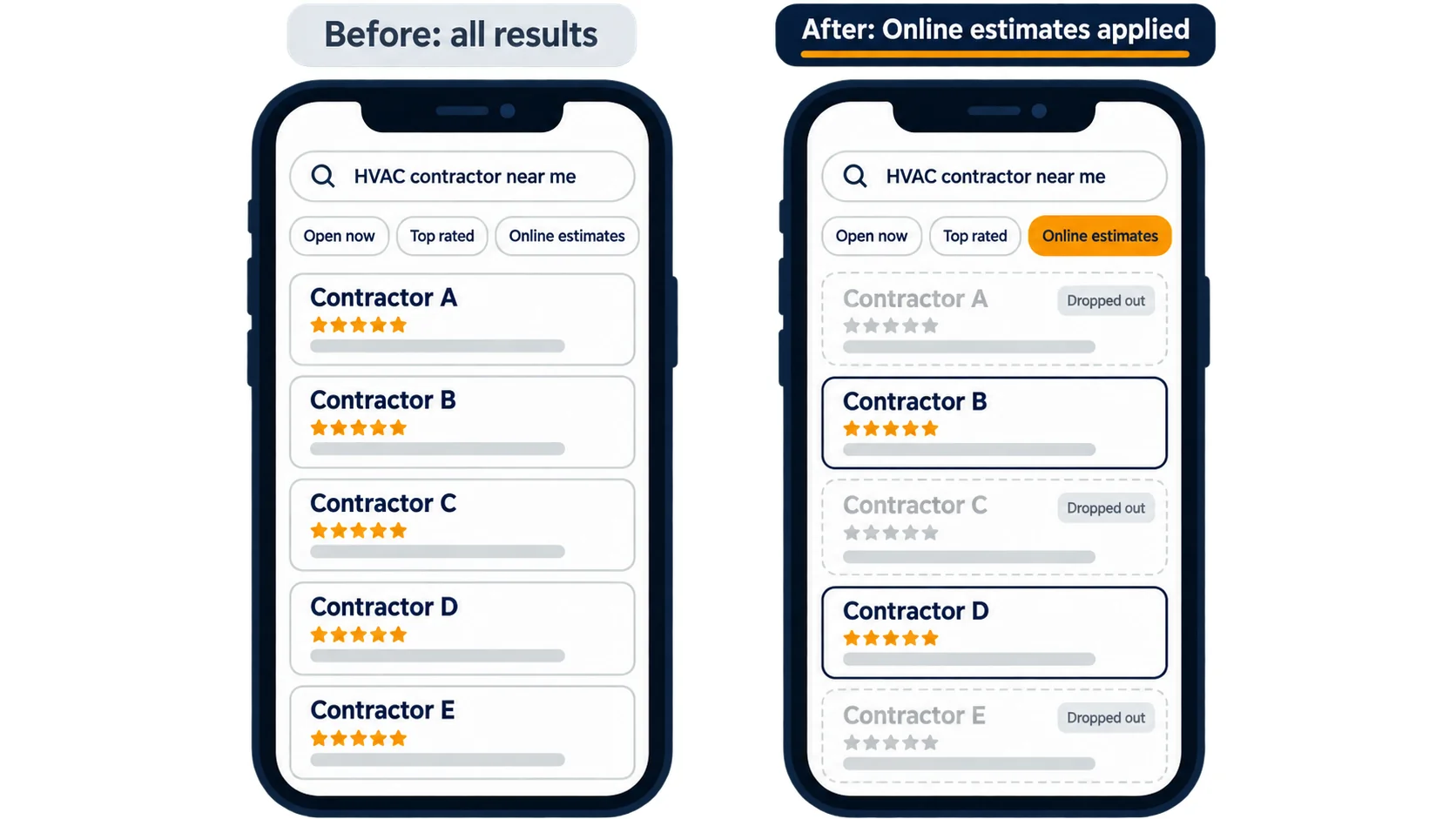
The short answer is no, at least not from Google as a whole. Online estimates is a filter the searcher chooses to apply. It doesn't replace Google's normal local results. But when a homeowner applies it, contractors that don't appear to offer online estimates may drop out of that comparison entirely.
Google hasn't published documentation on how the filter works or which businesses qualify. So this guide separates three things that often get mixed together: what Google officially documents, what people are observing in live search results, and what HVAC contractors should reasonably do about it.
What is the Online estimates filter?
It's a search refinement that appears on some local searches for home-service businesses. A homeowner searches something like "HVAC contractor near me" and sees a row of options for narrowing the results, including Online estimates. After they select it, the results narrow to companies Google associates with offering estimates online.
A filter works differently from a ranking factor. A ranking factor helps decide whether your company appears first, third or tenth. A filter changes which businesses are in the pool at all. An HVAC company could rank well in normal local results and still not appear when a homeowner specifically asks Google to show only companies that offer online estimates.
What Google has and hasn't confirmed
Google documents some pieces of this and not others. Keeping the two apart is the most important thing in this article.
What Google documents:
- Attributes can affect which searches you appear in. Business Profile attributes appear in Search and Maps. Google says adding certain attributes can help a business appear in searches for places with those characteristics (Manage your business attributes).
- Service businesses can list their services. They can publish services on their Business Profiles, with descriptions and, where available, prices (Manage your services).
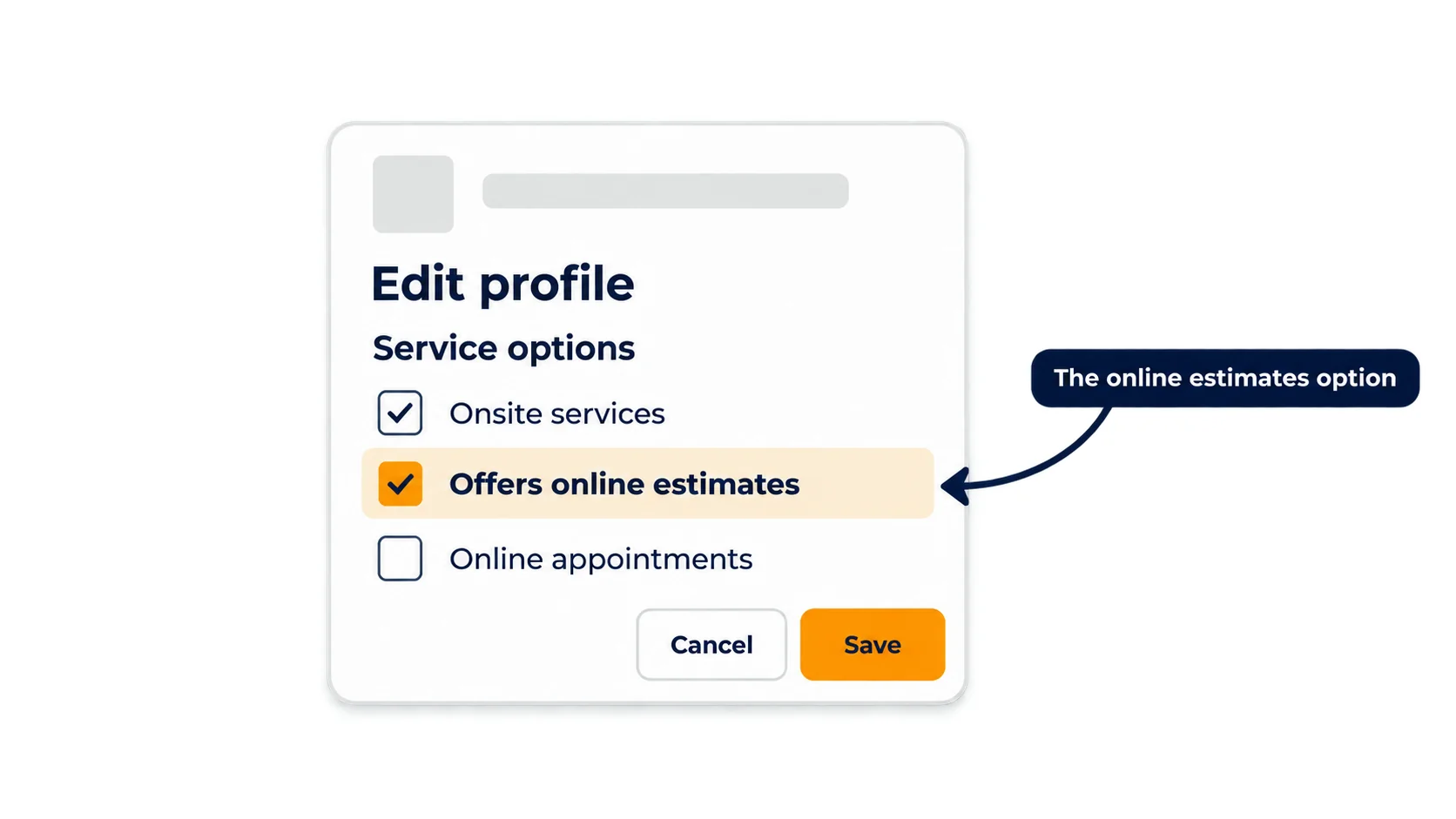
- "Offers online estimates" is an existing option. This service option has been available on eligible Business Profiles for years. Availability varies by business category and profile.
What Google hasn't documented:
- How widely the Online estimates search filter has rolled out.
- Which signals determine whether a business is included.
- Whether the Business Profile option alone is enough, or whether Google also looks at your website.
That means you should be skeptical of anyone presenting any of the following as established Google rules:
- "You must have an instant quote calculator to qualify."
- "Pricing has to appear within a certain number of seconds or minutes."
- "Adding a particular schema type will get you into the filter."
- "Turning on one Business Profile attribute guarantees inclusion."
- "Google uses your bounce rate or conversion rate to decide eligibility."
Some of these may turn out to be reasonable theories. None of them is a documented requirement today.
Why this matters beyond one filter
The filter matters because it reflects how homeowners already shop. Before calling anyone, many research what an AC or furnace replacement costs, whether a heat pump makes sense, what financing is available and which local companies have the best reviews. In a 2024 ACHR NEWS homeowner study, 91% of respondents rated online reviews as an important factor when choosing an HVAC contractor.
Yet on many HVAC websites, price is the one thing a homeowner can't find without talking to someone. Here's the traditional process next to an online estimate:
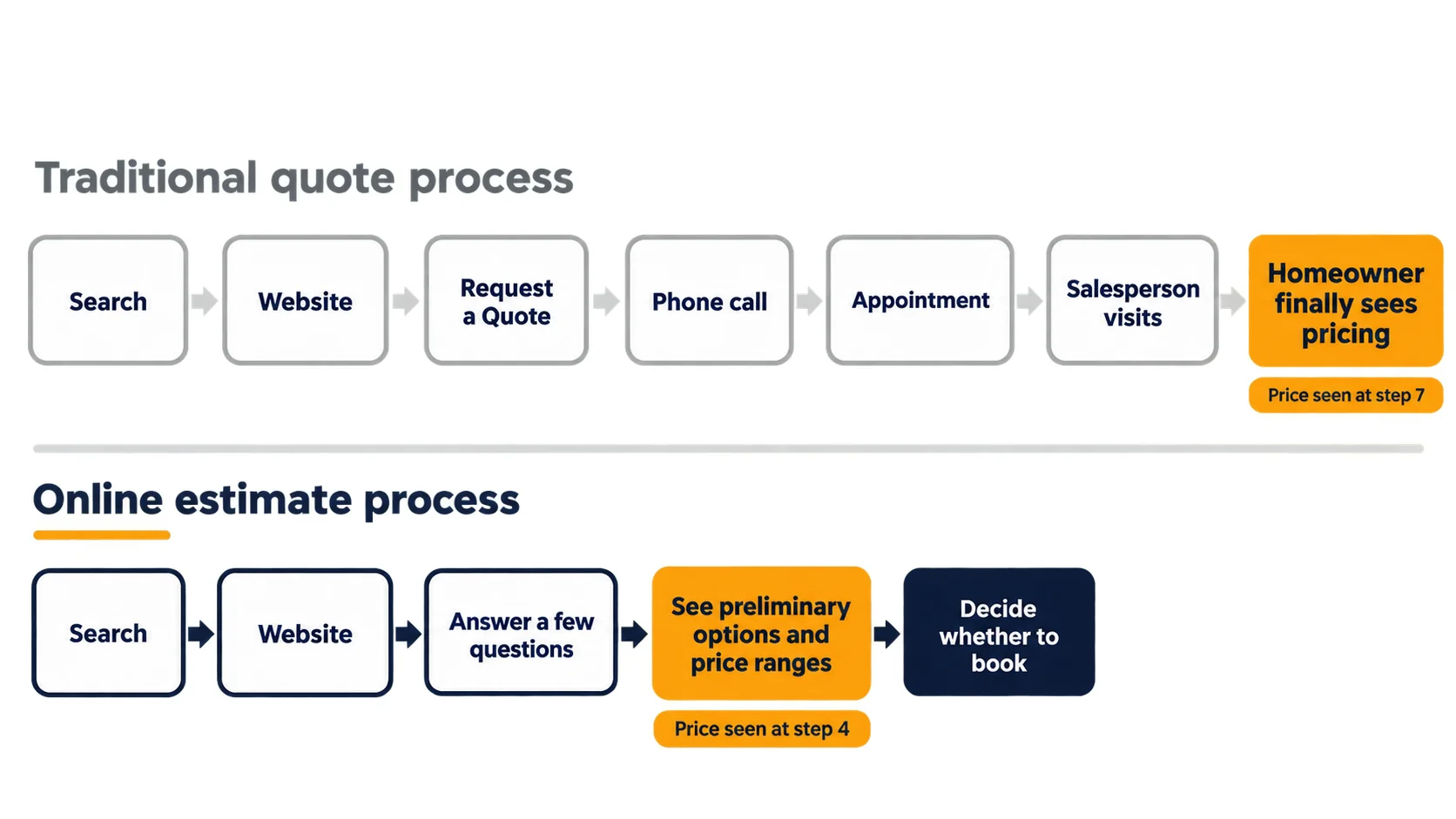
Google's filter brings that difference into the search results themselves. A homeowner no longer has to open five contractor websites to find out which ones will discuss pricing. They can tell Google: only show me the companies that do.
What an online HVAC estimate is, and what it isn't
Residential replacement pricing depends on too many variables for a single published price to make sense. Those variables include the home's heating and cooling load, existing equipment, ductwork and electrical condition, fuel type, efficiency level, system configuration, zoning, accessories, installation difficulty and available rebates. Proper equipment sizing also requires a load calculation. ACCA Manual J is the ANSI-recognized standard for residential heating and cooling loads.
So an online estimate isn't a final contract price. For HVAC, a useful definition is:
A preliminary price range and set of equipment options, based on what's known about the home, before final verification by the contractor.
That leaves a large middle ground between "publish an exact price" and "tell the homeowner nothing." An online estimate can answer the early questions: what type of system might make sense, roughly what capacity, which equipment tiers are available and what a realistic budget looks like. The in-home evaluation then does the work only a site visit can do: the load calculation, duct and electrical assessment, equipment placement, line-set and venting requirements, permits, rebate eligibility and final scope.
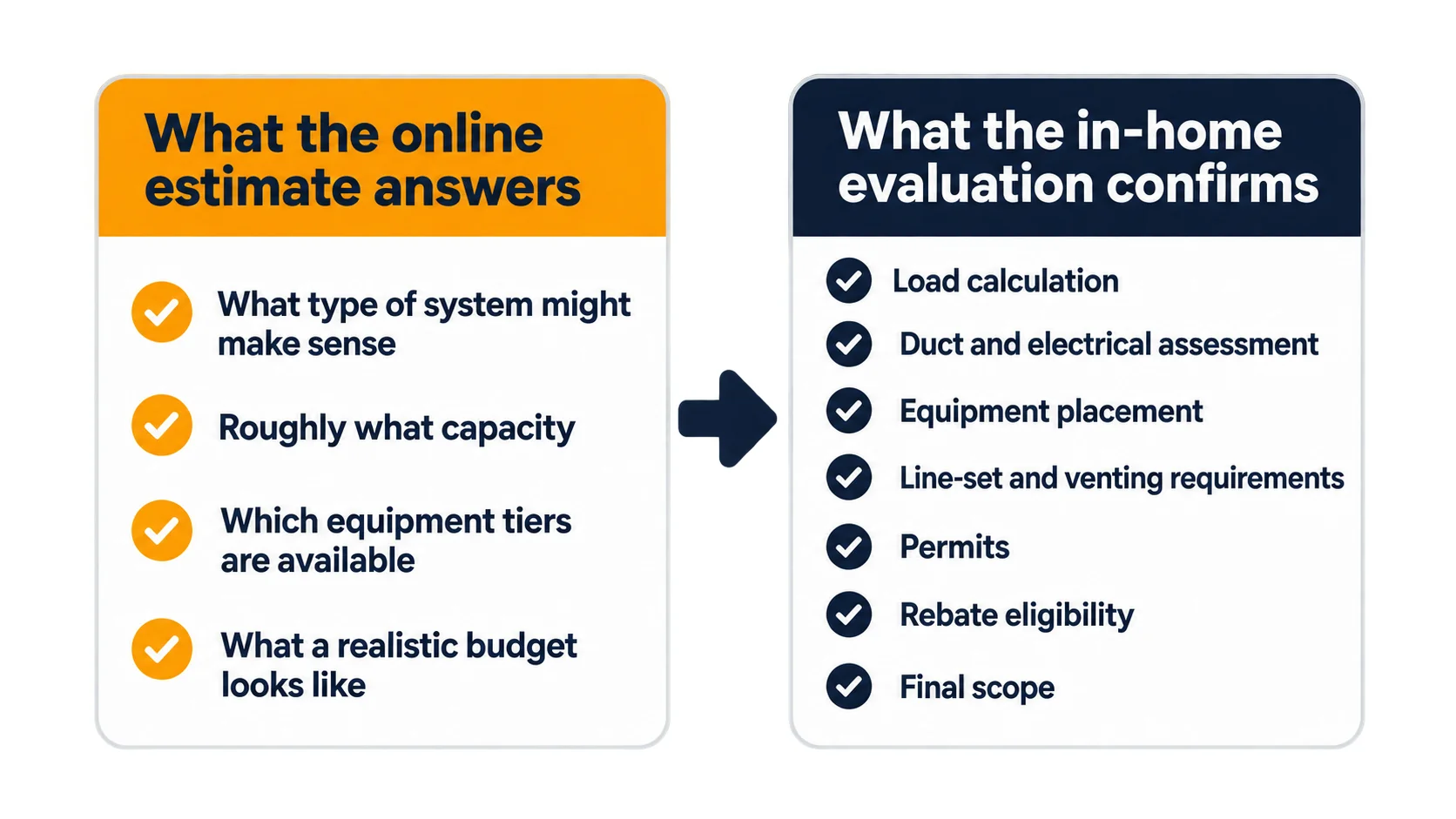
The estimate starts the sales and design process. It doesn't replace it. Its job is to answer one question: are we roughly in the right solution and budget range to keep talking?
What a useful online estimate shows
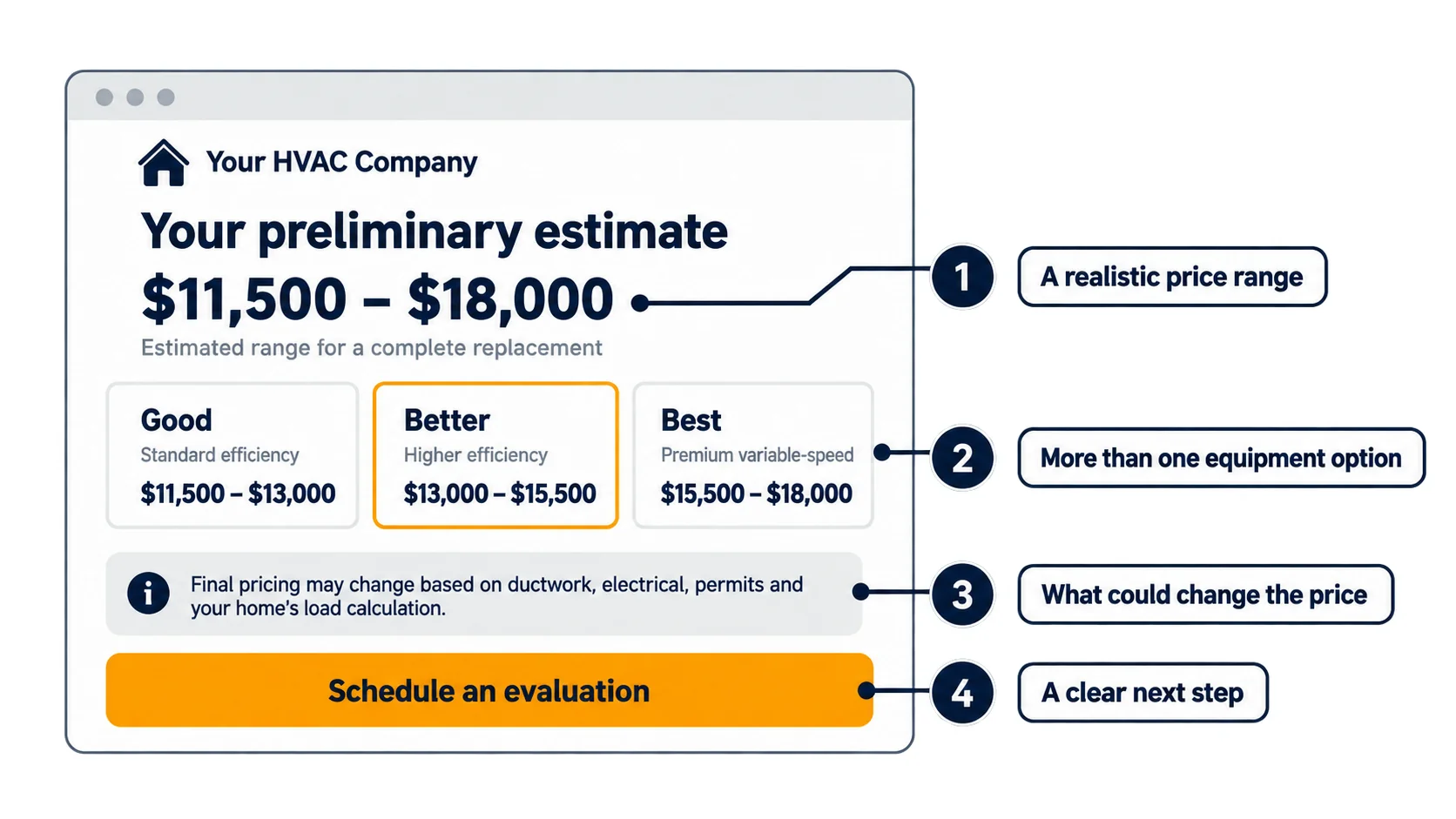
A strong online estimate gives the homeowner enough to decide whether the next step with your company makes sense. For a replacement lead, that usually includes four things.
A realistic price range. Skip "Systems starting at $4,999!" and give a range that reflects the property and system type:
Based on the information available for your home, a complete replacement will likely fall between $11,500 and $18,000, before any unusual ductwork, electrical or installation requirements are identified.
(Figures throughout this article are illustrative. Replacement costs vary widely by region, home and system type.)
More than one equipment option. Residential HVAC sales already work naturally as good, better, best, and an online estimate can introduce those tiers before the appointment:
| Option | Example positioning |
|---|---|
| Good | Reliable standard-efficiency replacement |
| Better | Higher efficiency, improved comfort and features |
| Best | Premium variable-speed, heat-pump or comfort-focused system |
This also explains to homeowners why one replacement can cost far more than another.
The factors that could change the price. Being transparent doesn't mean pretending the number is final. Say plainly what still needs to be verified, for example: "Final pricing may change based on ductwork, electrical requirements, equipment location, permits, accessories and the results of your home's load calculation." That protects you and educates the homeowner at the same time.
A clear next step. Don't send someone who has just seen their options to a generic contact page. Let them schedule an in-home evaluation, ask a question, request a call or tell you which option interests them most.
Is a "Request a Quote" form an online estimate?
Technically, a form labeled "Get a Free Estimate" lets a homeowner request an estimate online. From the homeowner's side, though, the experience is very different from actually receiving pricing online.
In one version, the homeowner enters their name, phone, email and address and sees "Thanks! Someone will contact you shortly." In the other, they describe their home and project and immediately see estimated equipment needs, several system options, preliminary price ranges, what drives the cost and a way to book.
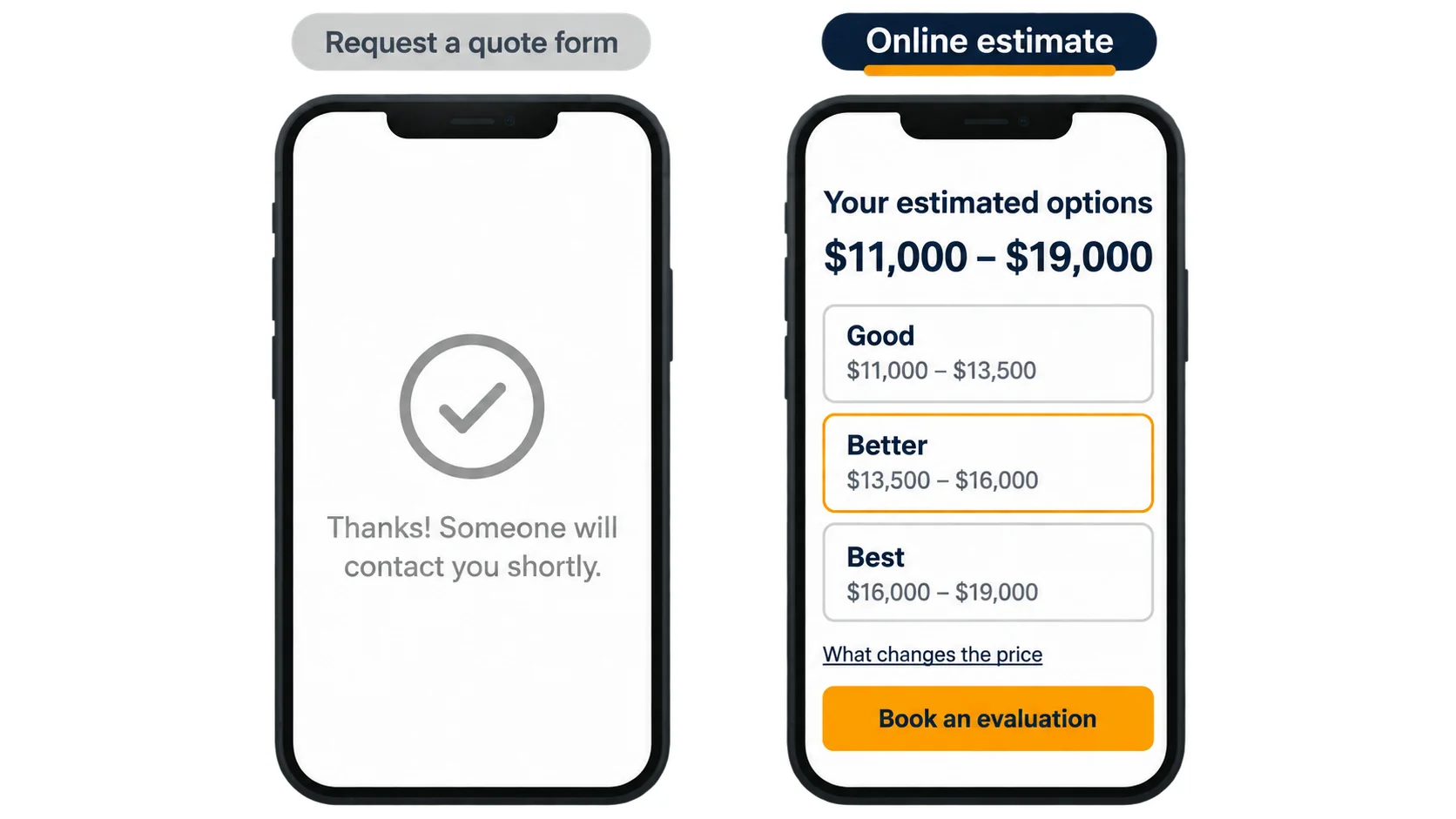
Both happen online, but only the second answers the homeowner's pricing question. Google hasn't said where it draws the line for the filter. The second experience is more valuable to a homeowner either way, so it's worth considering even if Google weren't involved at all.
The business case: better-qualified appointments
This may matter more than the filter itself. Consider two homeowners.
The first submits a generic web form. Your office calls, a comfort advisor drives out, and the homeowner looks at a $14,000 proposal and says, "I thought it would be around $6,000." It counted as a lead, but it was never a qualified one.
The second sees three replacement options, ranging from roughly $11,000 to $19,000, before booking. They understand what changes the price, pick the middle option and schedule an appointment. Your salesperson arrives knowing the homeowner has seen the likely investment and didn't walk away. The salesperson also knows which option they're leaning toward and has basic information about the home.
Seen this way, online estimating isn't giving away your price. It's moving price qualification earlier in the sale. That helps with problems HVAC owners complain about constantly: tire kickers, sticker shock, wasted sales appointments, repetitive pricing calls and comfort advisors tied up with weak opportunities.
It also helps after hours. A homeowner researching replacements at 9:30 p.m. doesn't expect anyone to answer the phone, but they still want to know what it might cost and whether you're worth calling tomorrow. A traditional form captures their details and waits. An online estimate keeps the conversation going, so your CSR or salesperson picks up a better-informed conversation the next morning. If you're paying for SEO, Google Ads, Local Services Ads or direct mail, much of that traffic lands on your site when no one is there to answer.
Be honest about the trade-off, though. Showing price ranges may reduce raw lead volume, because some homeowners will decide from the range that you're not for them. That's usually the point. Instead of judging the change by form submissions alone, track booked appointments, close rate and cost per sold job.
Common objections to putting prices online
"Every house is different." That's true, and it's exactly why ranges and preliminary estimates work better than fixed prices.
"My competitors will see my pricing." Competitors can already get your pricing by requesting an estimate or asking a customer. A range tied to property inputs also reveals much less than a line-item proposal does. It shows roughly where you sit in the market, and it doesn't show your margins.
"Customers will just shop the lowest number." Some will. But a homeowner who rules you out over an approximate range would most likely have done the same after a 45-minute drive and a two-hour appointment. The online range just saves you the trip.
"Homeowners will treat the online number as a final quote." Make the distinction impossible to miss. Call it a preliminary estimate, and say what it includes and what still has to be verified.
The more useful question isn't "should I publish my exact prices?" It's "how much pricing information should a homeowner get before I ask them to commit to an appointment?" For most residential replacement contractors, the answer is more than "call for pricing."
How to prepare
You don't need to rebuild your sales process around one partially rolled-out Google feature. A sensible response is simpler.
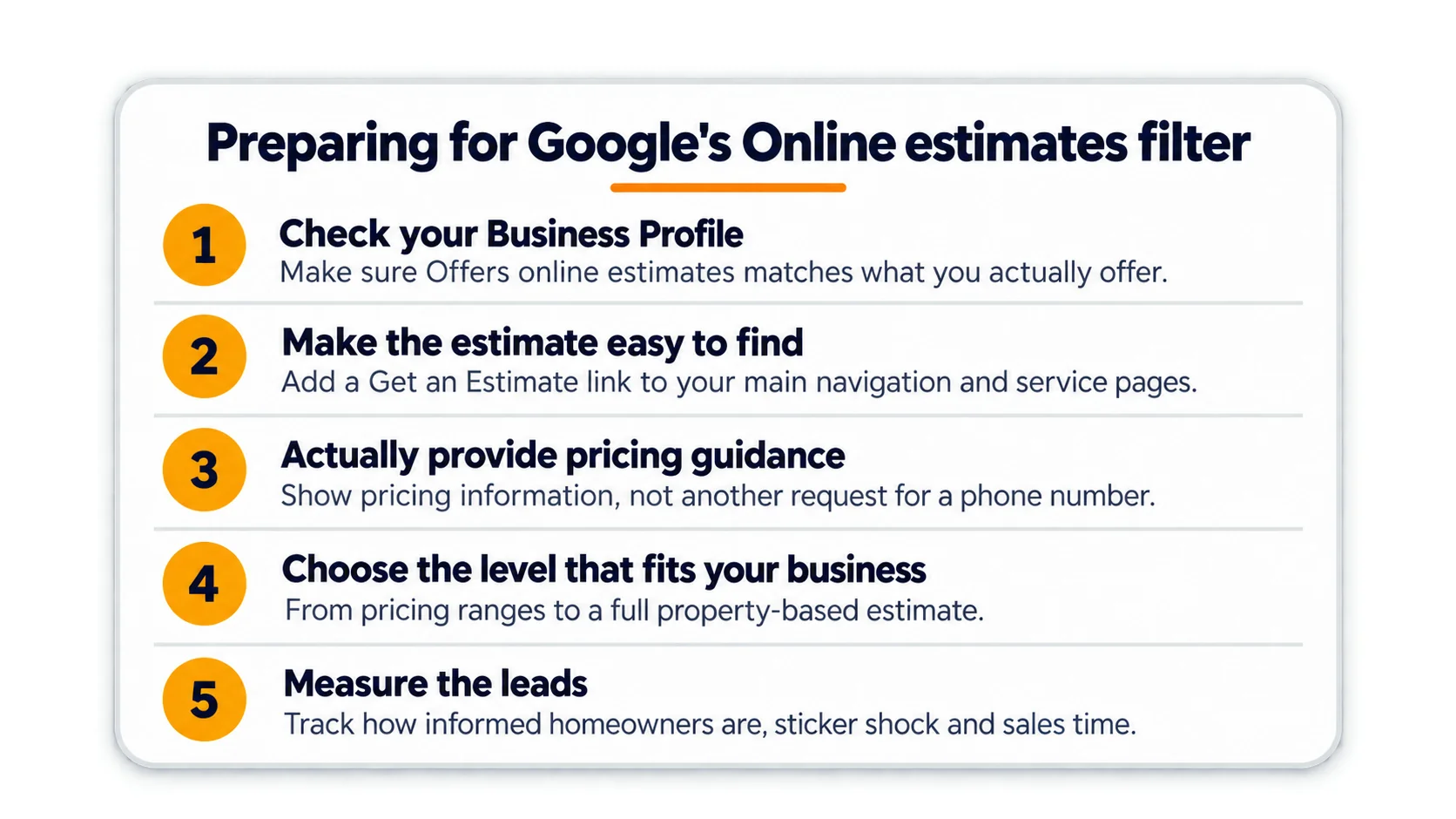
- Check your Business Profile. See whether Offers online estimates is available for your category, and make sure it accurately reflects what you offer. If you only have a contact form, think carefully before turning it on. A homeowner who filters for online estimates and lands on a phone-number form is likely to leave frustrated.
- Make the estimate easy to find. If you offer online estimates, put an obvious "Get an Estimate" link in your main navigation and on key service pages, so both homeowners and crawlers can see it.
- Actually provide pricing guidance. Someone who clicks expecting an estimate should get pricing information, not another request for their phone number.
- Choose the level that fits your business. Options range from educational pricing ranges and good-better-best examples to a full interactive, property-based estimate.
- Measure the leads. Are homeowners better informed? Is there less sticker shock? Are salespeople spending more time on viable replacements? Those outcomes matter whatever Google does with the filter.
For the detailed Business Profile and website setup, see my companion guide: How to Show Up in Google's Online Estimates Filter (HVAC).
The bigger shift
Whether this filter becomes permanent or changes in six months, the homeowner expectation behind it isn't going away. People are used to researching major purchases before they talk to a salesperson. HVAC has struggled to fit that model because every home is different. But "every home is different" doesn't have to mean "we can't tell you anything until Tuesday at 3:00."
Property data, online questionnaires, configurable equipment packages and automated follow-up now make it possible to give meaningful preliminary information without pretending the job has already been designed. That middle ground between ecommerce and "call us for pricing" is where online estimates are most useful for residential HVAC.
Where Instant Estimate HQ fits
Instant Estimate HQ is built for that middle ground. Instead of a generic request-a-quote form, contractors give homeowners a branded online estimate directly on their own website. A homeowner enters their property information and sees preliminary system recommendations, good-better-best options and realistic pricing guidance before talking to your team.
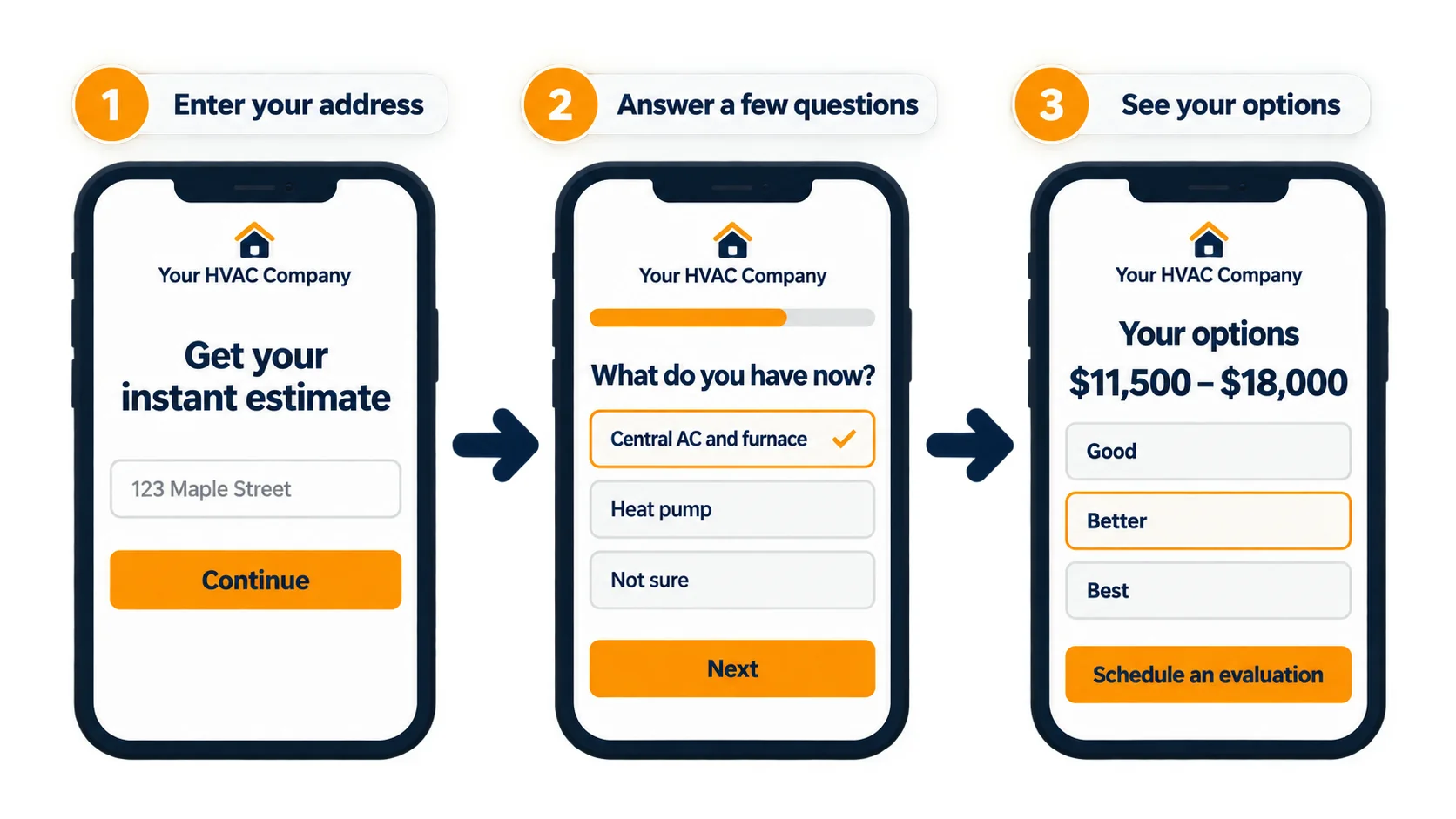
For you, that means leads arrive with context: the property, estimated system needs, the options they viewed, the approximate investment and what they're interested in. The goal isn't to replace your comfort advisor. It's to make sure your comfort advisor spends time with homeowners who already understand what they're considering.
And if Google's Online estimates filter keeps expanding, you'll already have something real behind the words "Offers online estimates."
See Instant Estimate HQ in action or book a call.
Frequently asked questions
Will turning on "Offers online estimates" guarantee I appear in the filter?
Google hasn't said so, and nobody outside Google knows the full criteria. Keep the option accurate if you genuinely offer online estimates, and be wary of anyone promising guaranteed inclusion.
Where do I find the setting?
For eligible categories, it's in the attributes or service-options area of your Google Business Profile. Google changes this interface periodically, and not every profile shows the same options. Step-by-step walkthrough here.
Do I need an instant price calculator?
Google hasn't published any requirement for a specific tool. An interactive estimator gives homeowners a strong experience, but the underlying goal is simply that they can get useful pricing guidance without waiting for a sales call.
Does the filter affect my normal Google rankings?
The filter only changes what a homeowner sees when they choose to apply it. Your visibility in unfiltered local results still depends on the usual local ranking factors.
Will showing price ranges reduce my leads?
It may reduce total form submissions, because some homeowners will self-select out. Many contractors find the leads that remain are better qualified, so compare booked appointments and close rates, not just lead counts.
Is it risky to enable the option if I only have a quote form?
It creates a mismatch. A homeowner who specifically filtered for online estimates and then finds only a contact form is likely to move on. If you enable it, make sure the experience behind it delivers pricing guidance.
Sources and further reading
- Google Business Profile Help: Manage your business attributes
- Google Business Profile Help: Manage your services on your Business Profile
- Google Business Profile Help: Business Profile for service businesses overview
- Google Business Profile Help: Edit your Business Profile
- ACCA: Manual J Residential Load Calculation
- Instant Estimate HQ: How to Show Up in Google's Online Estimates Filter (HVAC)
Changelog
- September 2026: Rewritten and condensed; linked sources inline.
- June 2026: Original publication.
Editor's note: Google's Online estimates filter remains incompletely documented as of September 2026. I'll update this article as Google publishes guidance or the feature changes.