Should HVAC Contractors Put Prices on Their Website?
Jay, InstantEstimateHQ
Last updated: September 2026
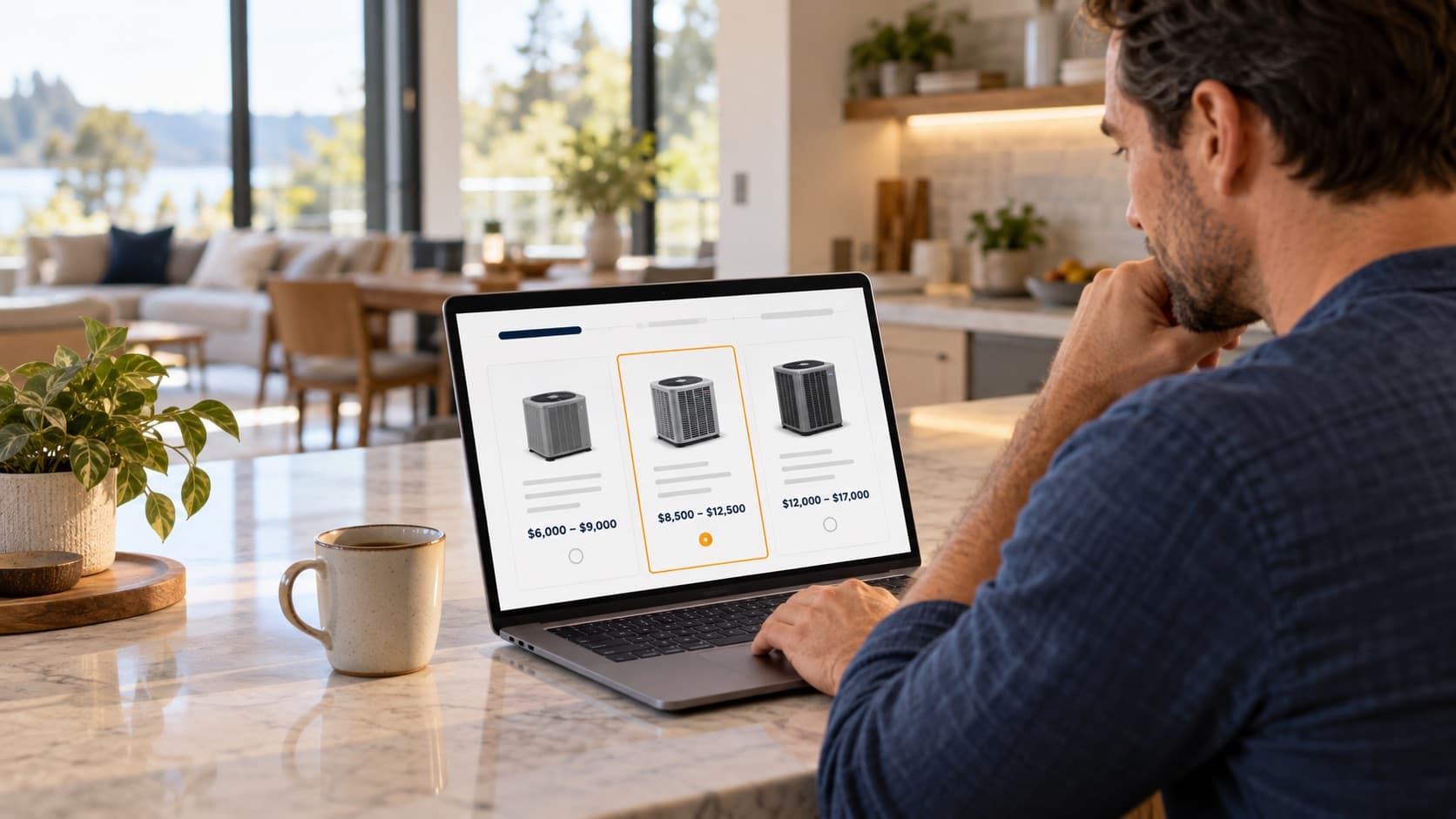
For most residential HVAC companies, especially those focused on system replacements, the answer is yes. That doesn't mean publishing one fixed price for every installation.
There's a big difference between:
"A new HVAC system costs $12,499."
and:
"Most complete system replacements like yours fall between $11,500 and $19,500, depending on equipment efficiency, system size, ductwork, electrical requirements, and installation conditions."
The first can create problems. The second gives homeowners something they increasingly want before contacting a contractor: a realistic idea of what the project might cost.
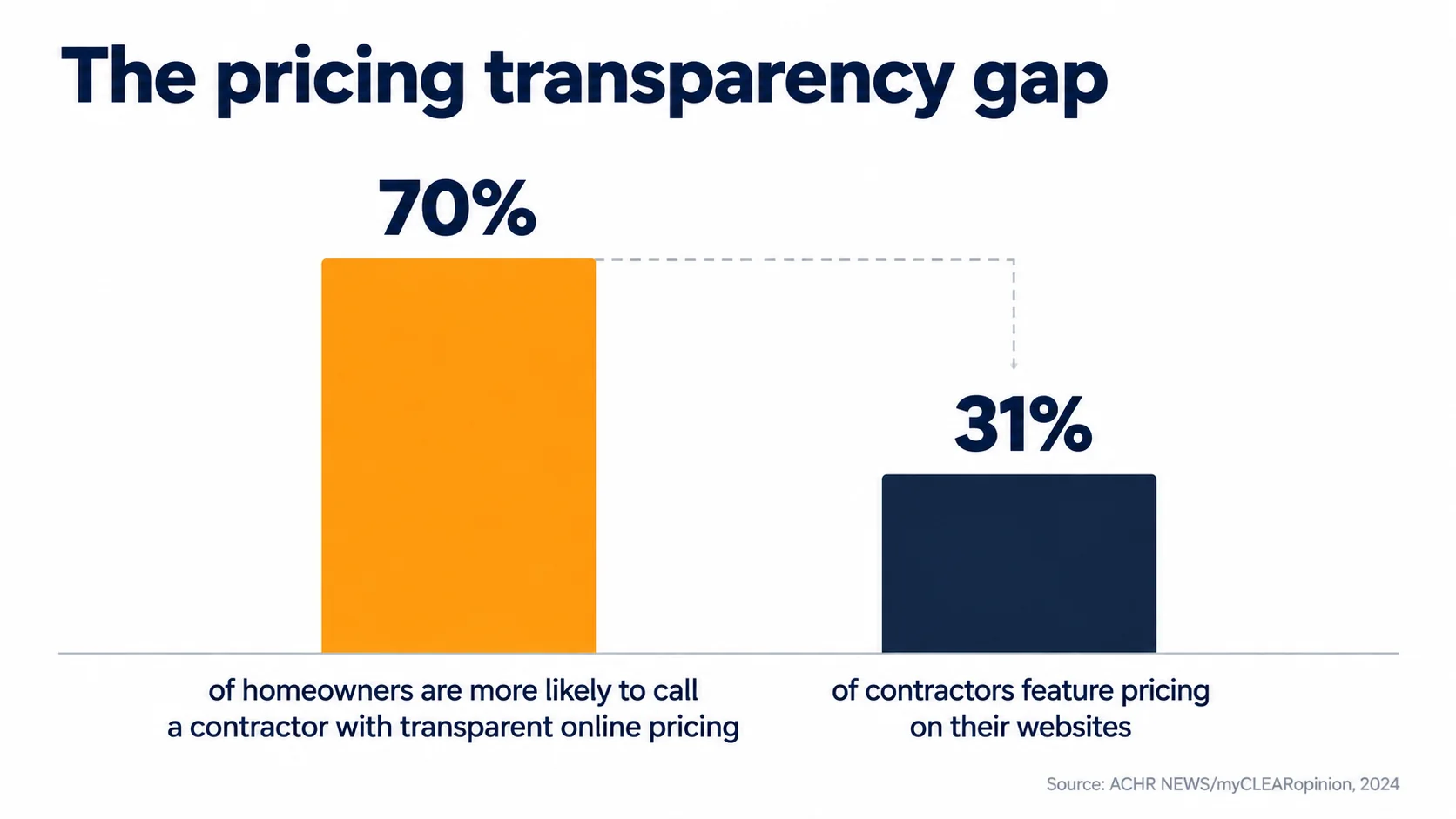
Homeowners appear to value that transparency. In a 2024 ACHR NEWS/myCLEARopinion survey, 70% of homeowners said they were more likely to call an HVAC contractor that was transparent about pricing online, while only 31% of contractors surveyed said they displayed pricing on their websites.
So the real question isn't whether you should publish your entire pricebook. It's this:
How much pricing information can you give homeowners before the sales appointment without misleading them or locking yourself into a price you can't honor?
For most residential contractors, there's a useful middle ground.
A note on the numbers in this article: all dollar figures are illustrative. Installed prices vary widely by market, so build your own ranges from your own completed jobs.
Why don't more HVAC contractors show prices online?
There are legitimate reasons. A restaurant can put "$19" next to an entrée because the product is standardized. An HVAC replacement isn't.
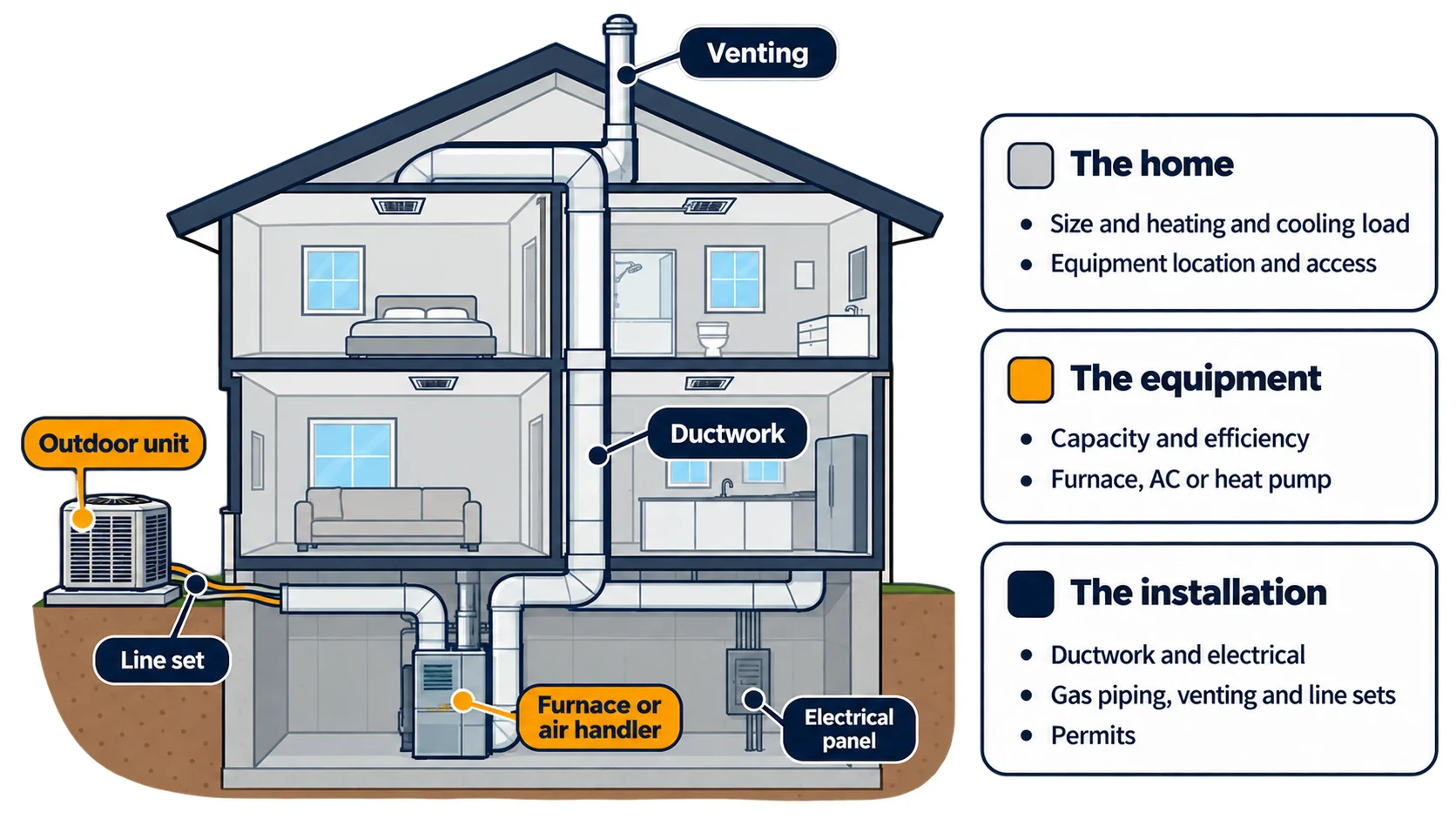
The final price depends on the home (size, heating and cooling load, equipment location, accessibility), the equipment (capacity, efficiency, furnace, AC, or heat pump configuration, accessories, zoning), and the installation (ductwork, electrical, gas piping, venting, line sets, permits, and local labor and material costs). Rebates and incentives move the number again. Two homeowners asking for "a new 3-ton air conditioner" can end up with very different scopes of work.
That's why so many contractors default to "Call for pricing" or "Schedule a free estimate." The reasoning makes sense. The problem is that it asks the homeowner to commit to a sales conversation before answering their most basic question: What is this roughly going to cost me?
What do homeowners actually mean when they ask for a price?
Usually they aren't asking you to guarantee the final invoice before inspecting the property. They're trying to understand the size of the purchase. Is this a $5,000 decision, a $10,000 decision, or a $20,000 decision?
That matters. A homeowner deciding whether to repair a 14-year-old system needs to understand replacement costs first. Someone weighing a heat pump against another gas furnace needs a rough investment range. Someone considering financing needs to know approximately how much they'd be financing. And someone gathering three estimates wants to know whether your company is even within their budget before taking time off work for an appointment.
Giving them a realistic range doesn't mean pretending you already know everything about their house. It means answering the question you can answer while being clear about what you still need to verify.
Does putting HVAC prices online actually help generate leads?
It can, but not because "Google likes pricing" or because every homeowner picks the most transparent website. The reason is simpler: pricing removes uncertainty.
The 70% figure above doesn't mean 70% of homeowners will choose the cheapest contractor. It means transparency makes them more willing to start the conversation.
Your website's job isn't to close a $15,000 replacement without human involvement. Its job is to move a homeowner from "I don't know what this company charges" to "I understand what this will probably cost, these options make sense, and I'm comfortable taking the next step." That's a smaller and much more achievable goal.
Start with the easy prices: service and maintenance
Most of this article is about replacement pricing, because that's where contractors hesitate. But some of your prices are easy to publish outright, and they're a good place to start.
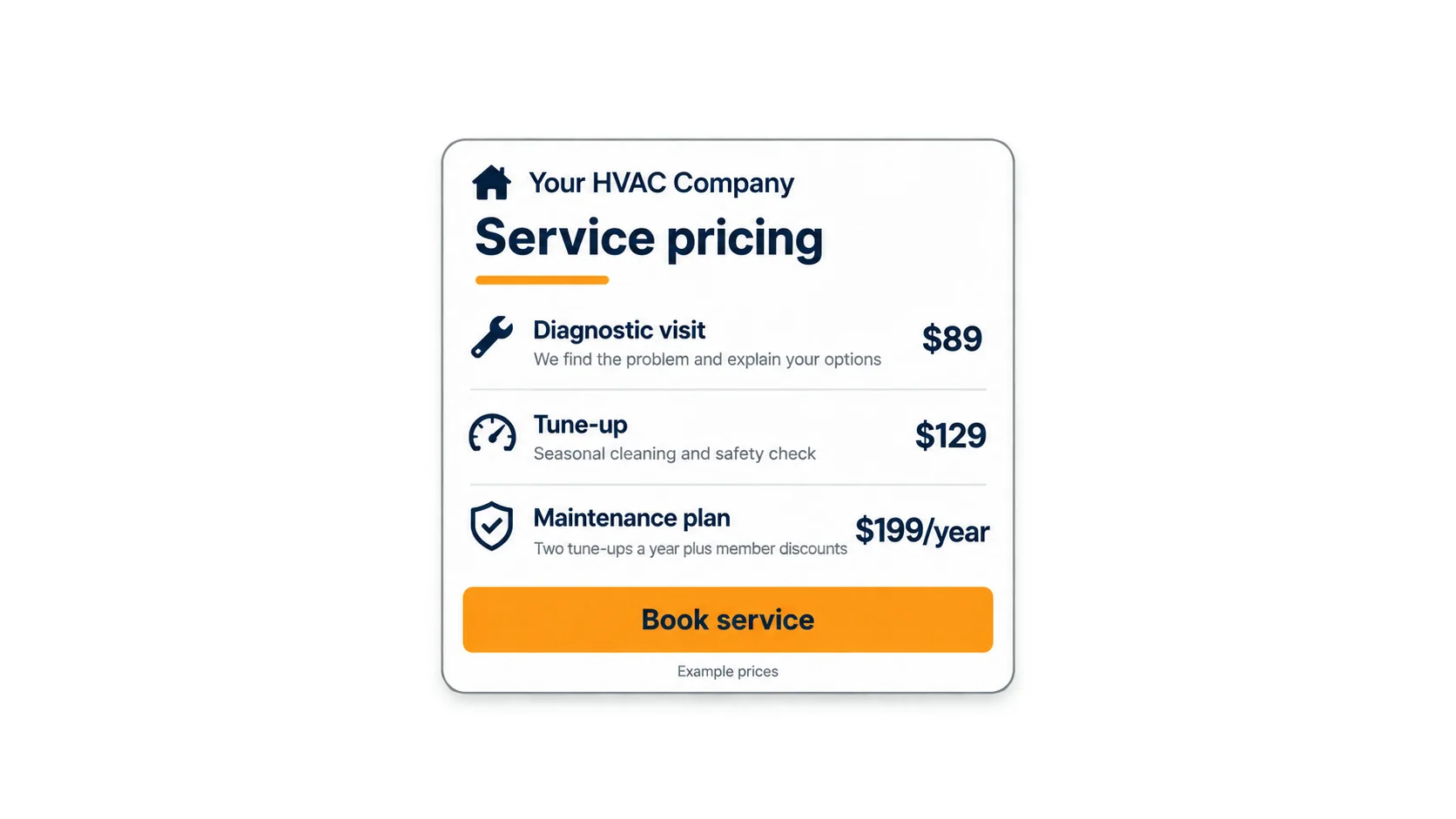
Diagnostic or service-call fees, tune-up and maintenance-visit prices, and maintenance-plan memberships are standardized enough that a single published price is honest and useful. Showing them builds trust at low risk, and it signals to visitors that you aren't hiding numbers. Save ranges and estimates for replacements, where the variables really do matter.
Should I publish exact replacement prices or price ranges?
For residential replacement work, ranges usually make more sense than one universal fixed price. There are four common levels of transparency.
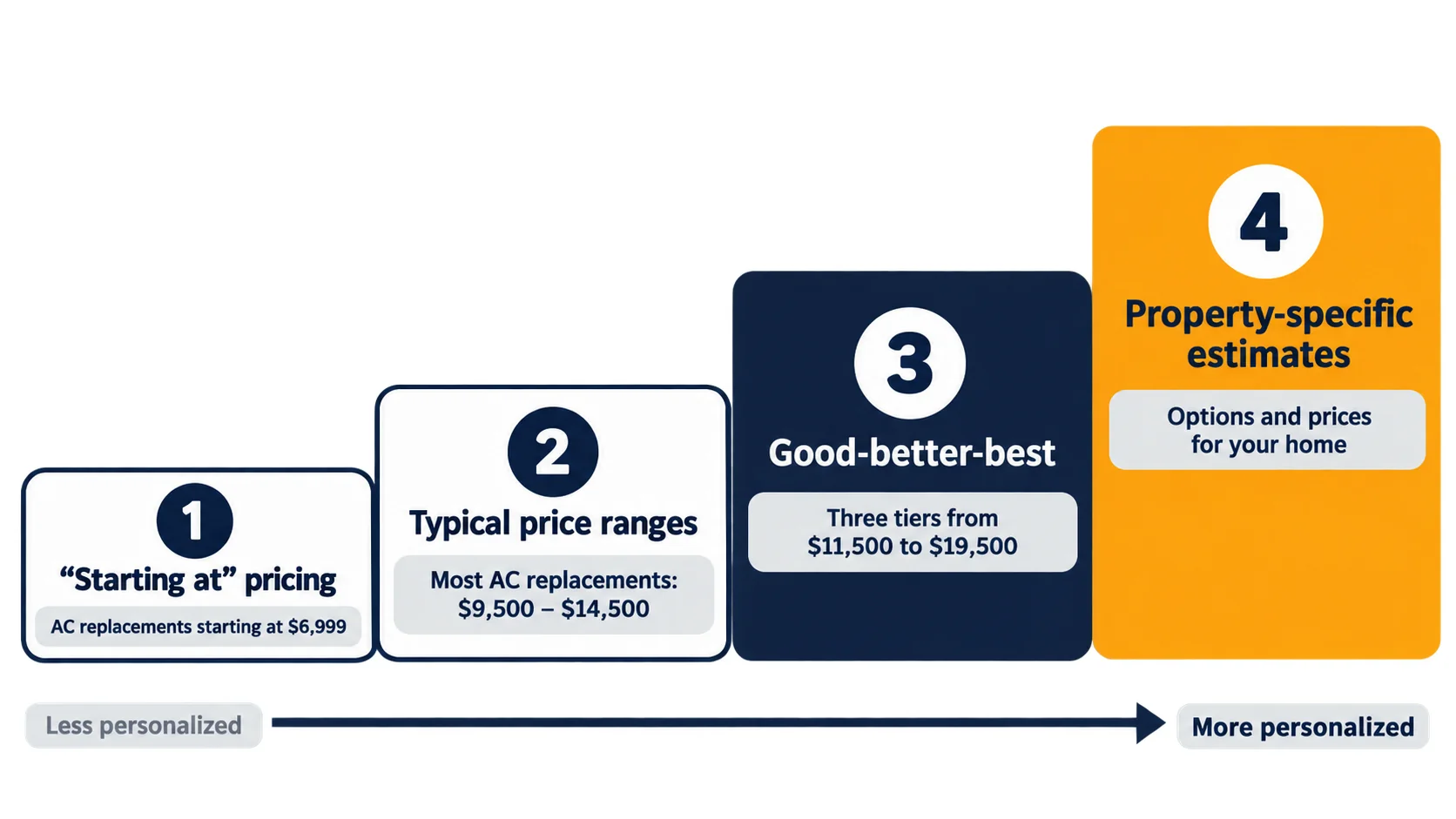
Option 1: "Starting at" pricing
Complete AC replacements starting at $6,999.
This is easy to implement and the least informative. If few homeowners actually qualify for the starting price, it creates the exact trust problem transparency is supposed to solve. A low headline number followed by a much higher in-home proposal feels less transparent, not more.
It can also create legal exposure. Advertising a price that few customers can actually get may raise deceptive-advertising concerns under FTC and state consumer-protection rules. If you use a starting price, make sure it reflects a realistic, complete job you genuinely sell.
Option 2: Typical price ranges
Most complete AC replacements we install range from $9,500 to $14,500, depending on system size, efficiency, electrical requirements, ductwork, and installation conditions.
This is much more useful. The homeowner understands the general investment without mistaking it for a final proposal. You can publish ranges for AC replacement, furnace replacement, furnace-and-AC systems, heat pumps, dual-fuel systems, and ductless mini-splits. If you're not ready for personalized online estimates, start here.
Option 3: Good-better-best pricing
Instead of one range, show several levels, each with its own approximate installed price:
| Option | Positioning | Example system | Illustrative price |
|---|---|---|---|
| Good | Reliable replacement | Standard-efficiency system | $11,500–$13,000 |
| Better | Efficiency + comfort | Higher-efficiency, two-stage equipment | $14,000–$15,500 |
| Best | Maximum comfort | Variable-speed or premium heat pump | $17,000–$19,500 |
This mirrors how many successful contractors already sell in the home. If you show one system at $15,000, the homeowner's decision is yes or no. If you show three, the decision becomes "Which option fits my priorities?" The lowest tier sets a realistic entry point, the middle tier offers a value comparison, and the top tier introduces higher efficiency and comfort. Make sure the tiers reflect real differences in equipment or system design, not arbitrary markups.
Option 4: Property-specific online estimates
Here the homeowner provides their address, home details, current system, fuel type, and comfort priorities, and an estimating tool produces preliminary options and pricing for that particular home. It offers personalization without pretending the final job has already been designed. I cover this in more detail below.
How do I give ballpark pricing without underselling myself?
Build your online pricing around what you actually sell, not the cheapest job you've ever installed.
Start with your completed replacement jobs. Look at average installed price, common capacities and equipment tiers, typical gross margin, usual accessories, labor, permit costs, electrical and duct work, and how prices differ across your service area. Then set realistic ranges.
If most of your complete AC replacements land between $9,500 and $14,500, putting "AC replacement starting at $6,999" on your website to generate leads sets the wrong expectation. Homeowners aren't necessarily looking for the lowest number. They're looking for an answer they can trust. A better version:
Most complete AC replacements we install fall between $9,500 and $14,500. High-efficiency equipment, electrical upgrades, duct modifications, difficult equipment locations, and other installation requirements can increase the final price.
Now you're setting an expectation rather than advertising a teaser, and you've left yourself room to explain value.
Won't homeowners just choose the cheapest contractor?
Some will. But they would have shopped on price whether or not you published yours. Hiding your pricing doesn't eliminate price shoppers. It just means you identify them later, after you've spent money on them.
Without pricing online: A homeowner fills out your form, your CSR follows up, and your comfort advisor drives 35 minutes to the home. They inspect the system, build a proposal, and present a $14,500 replacement. The homeowner says, "That's way more than I thought this would cost." The lead wasn't necessarily bad, but a budget mismatch that could have surfaced on day one surfaced after hours of work.
With preliminary pricing online: The homeowner sees good, better, and best options from roughly $11,500 to $19,500, continues through the estimate, and books an appointment. Your salesperson now knows this homeowner has seen the approximate investment and chose to continue anyway.
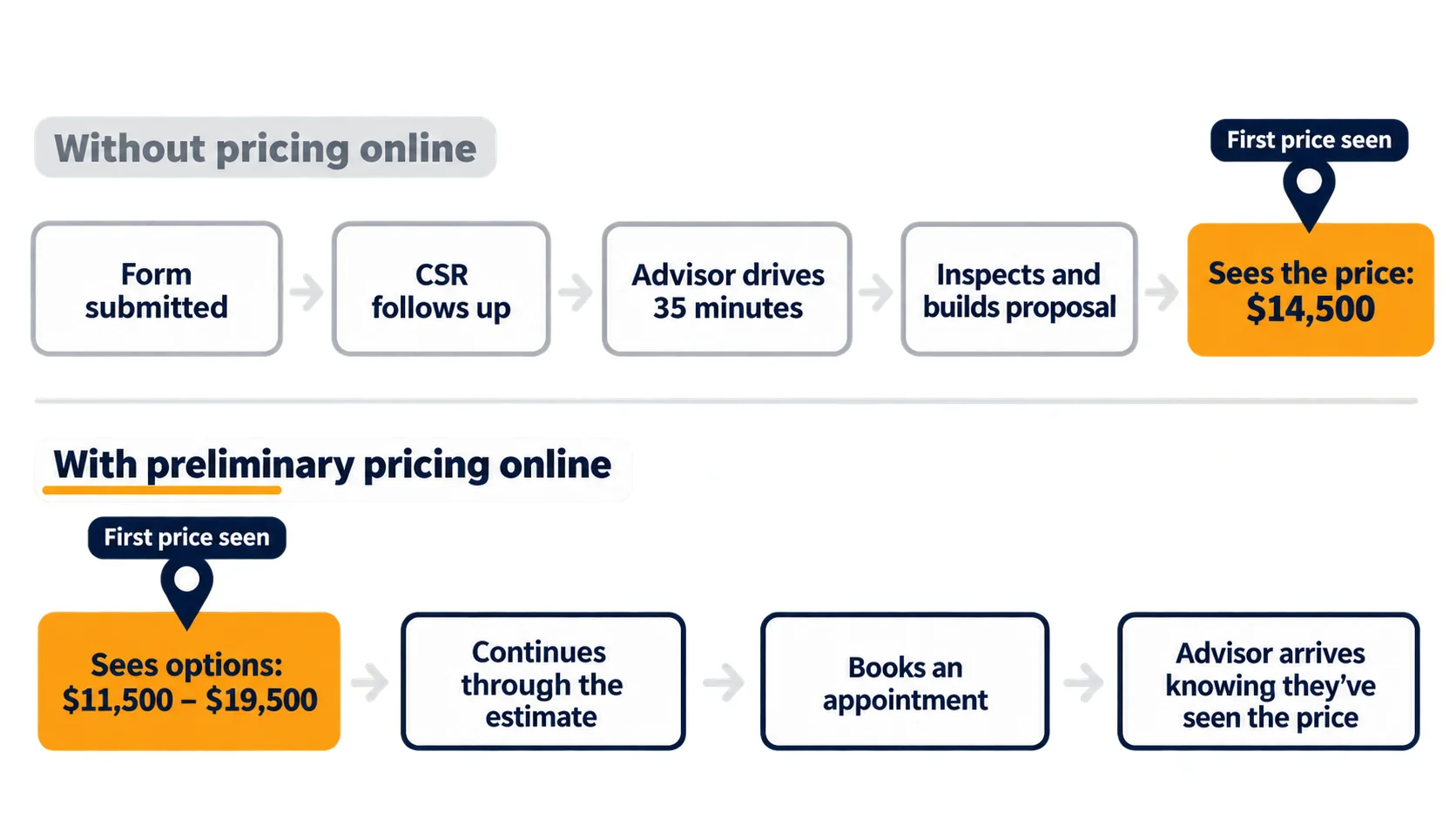
Pricing transparency doesn't remove price shoppers. It moves price qualification earlier in the process, which is valuable even if it doesn't bring in a single additional visitor.
What if homeowners keep asking for prices over the phone?
That's a sign your website isn't answering a question homeowners care about.
Many companies train CSRs to say "We really can't give you any idea until we come out." That may be true for the final price. It isn't true for the likely range, and you can communicate both:
"There are too many variables for us to give you a final price without seeing the home, but most complete AC replacements we install fall between roughly $9,500 and $14,500. System size, efficiency, ductwork, electrical work, and installation conditions can move that up or down. We can narrow it down a lot once we know more about your home."
That answer gives the homeowner useful information, protects you from promising a final price, and establishes the investment level before the appointment. Your website can do the same thing automatically.
Can you estimate a replacement without visiting the house, and how accurate can it be?
You can provide a preliminary estimate remotely. A final installation proposal is different. You may still need to verify actual heating and cooling loads, duct sizing and condition, electrical capacity, venting, gas piping, line sets, condensate drainage, equipment access, and code requirements.
That's why terminology matters. An online estimate should say what it is:
This is a preliminary replacement estimate based on the information currently available about your home. Final equipment selection and pricing are subject to an in-home evaluation and verification of installation conditions.
That's very different from "Guaranteed installed price: $12,487," which you should only publish if you're prepared to honor it regardless of what you find.
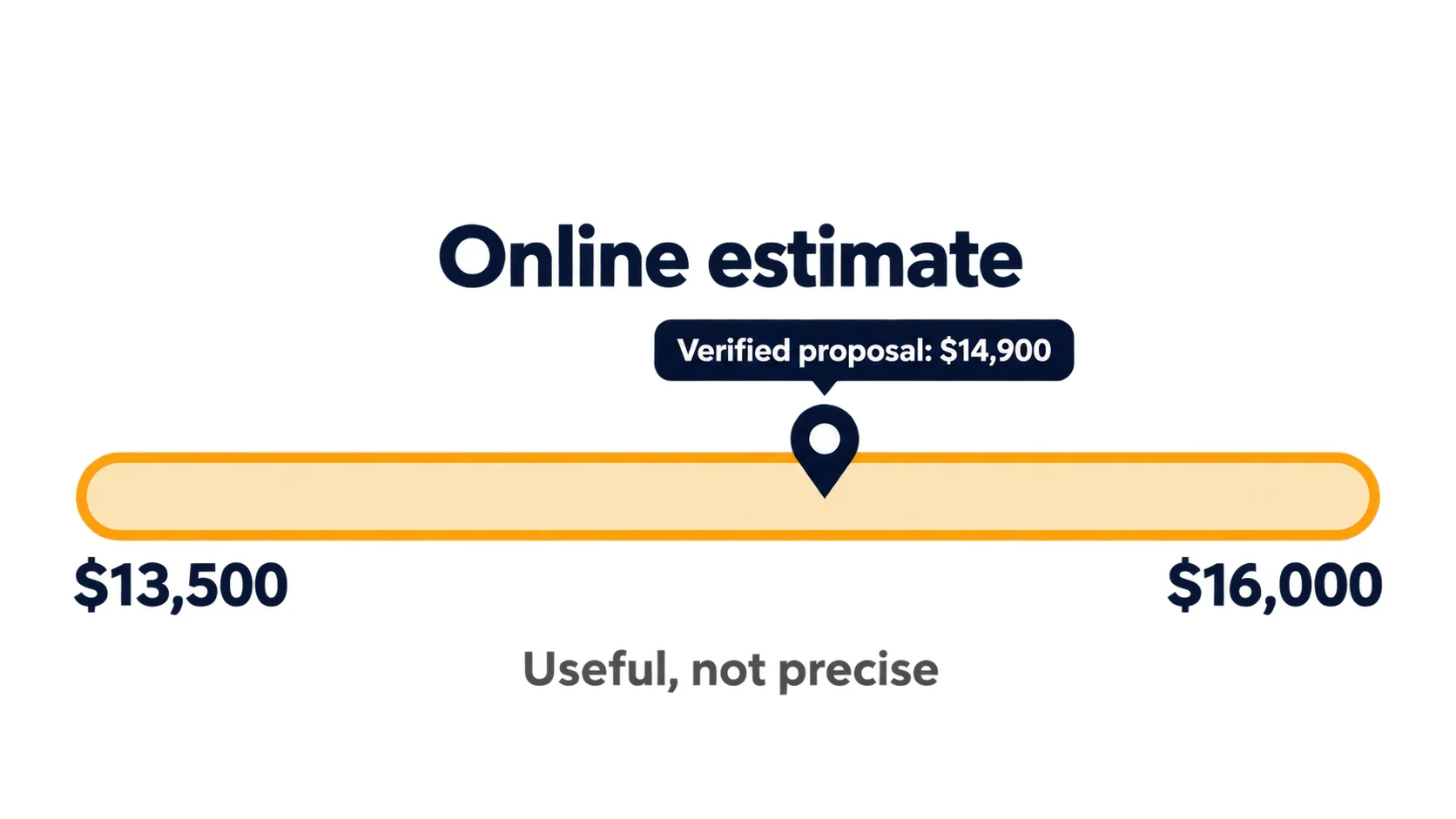
As for accuracy, the goal is useful, not precise. If your online estimate says $13,500–$16,000 and the verified proposal comes in at $14,900, the estimate did its job: it prepared the homeowner for the investment and let them decide whether to continue. Problems start with false precision, like "Your exact replacement price is $13,742.16," which implies certainty you don't have yet. Ranges let you be open about uncertainty instead of hiding behind it.
What factors should I tell homeowners can change the final price?
Don't just put an asterisk next to your price and write "Restrictions apply." Explain the variables. Depending on your market, the final price may change because of ductwork repairs or modifications, electrical panel or circuit upgrades, difficult attic or crawlspace access, crane requirements, line-set replacement, gas-line or venting changes, zoning, permits, equipment relocation, accessories, code issues discovered on site, or a change in equipment selection.
When you explain why a price might change, it reads as education rather than an escape hatch. ACCA has similarly emphasized educating homeowners about what goes into professional HVAC pricing: skilled labor, licensing, insurance, vehicles, training, and overhead.
Should I show financing instead of the total price?
Show both. Monthly payments help homeowners understand affordability, but hiding the total behind "Starting at $149/month" creates its own transparency problem. Homeowners should be able to see the approximate installed price, available financing, an example monthly payment, and the key terms behind it.
Be careful here. In the US, advertising a specific monthly payment generally triggers additional disclosure requirements under the Truth in Lending Act (Regulation Z), typically including the down payment, repayment terms, and APR. Present monthly figures as a complete example:
Estimated installed price: $14,000–$15,500
Example: $14,800 financed over 120 months at 9.99% APR is about $196/month, subject to credit approval. Other terms available.
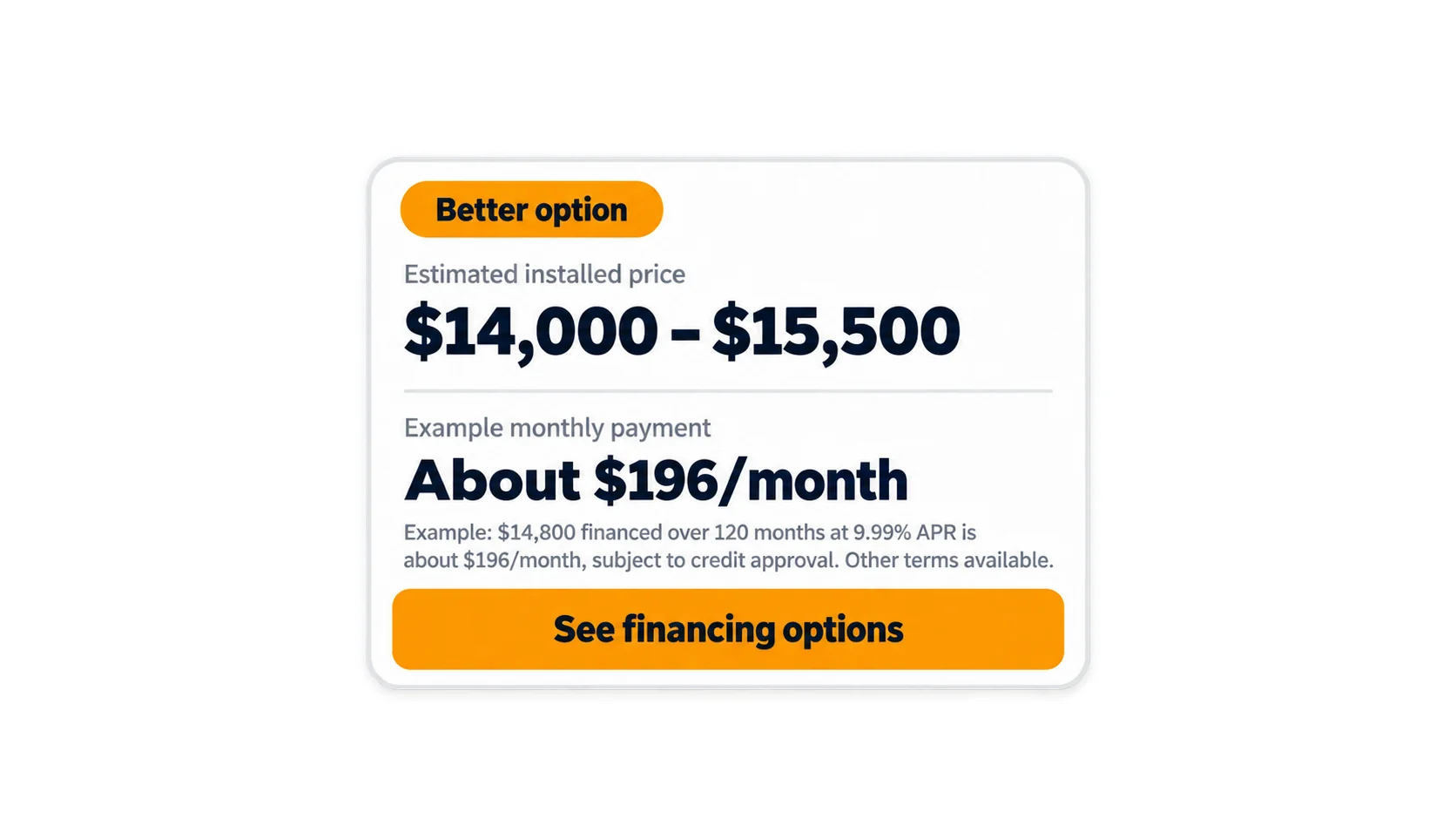
Confirm the exact wording with your financing partner, who usually has approved advertising language, and with legal counsel if you're unsure.
What if my competitors can see my prices?
They can. But publishing consumer-facing pricing doesn't mean publishing your pricebook. There's a big difference between "Typical high-efficiency heat pump replacements: $14,000–$19,000" and your equipment cost, labor hours, markup, commission, and overhead allocation. The homeowner needs the first. Your competitor doesn't get the second.
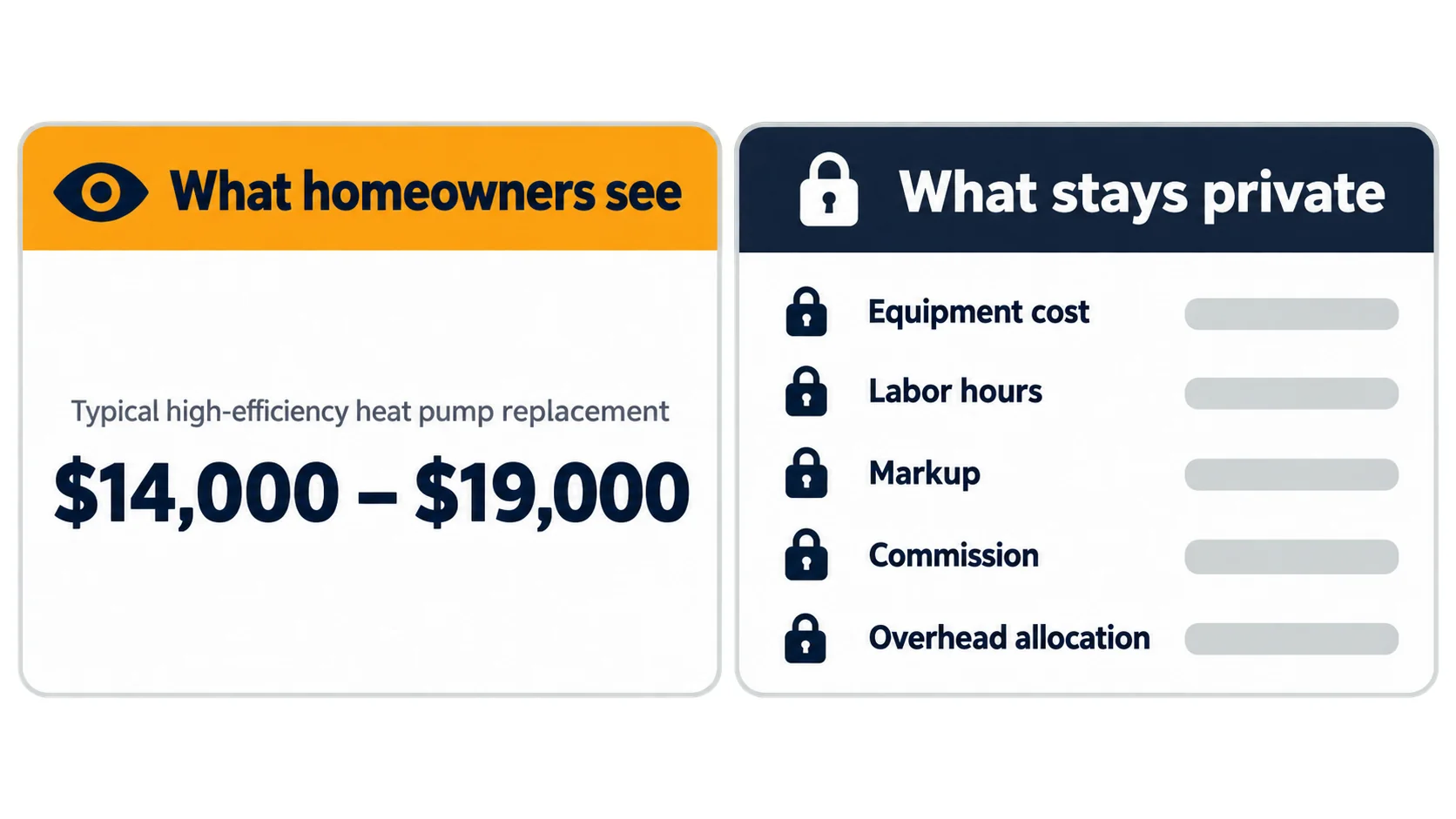
Realistically, established competitors already have a general idea of where you price replacements. Your pricing isn't your deepest competitive secret. Your reputation, installation quality, warranties, response time, financing, maintenance program, and sales process are much harder to copy.
How do I compete with companies that already show prices?
Don't assume you need to beat their price. You need to beat their buying experience.
If a competitor advertises "New HVAC systems starting at $7,999. Call today," you don't win by posting $7,499. That's a race you don't want to win. Instead, give more useful context:
Based on your home, here are three replacement options ranging from approximately $11,500 to $19,500, from a dependable standard-efficiency replacement to a premium variable-speed heat pump.
Now you're helping the homeowner understand why prices differ, and competing on clarity instead of the lowest advertised number. That's a much healthier position for a quality contractor.
Will online pricing cost me appointments or hurt my sales team?
It may reduce the number of appointments. That isn't necessarily bad.
Suppose 100 homeowners submit replacement forms and 30 of them expected a complete system to cost half of what you charge. Your team still responds, qualifies, schedules, drives, and builds proposals before discovering the mismatch. If online pricing lets some of them self-select out earlier, you get fewer but better-qualified appointments.
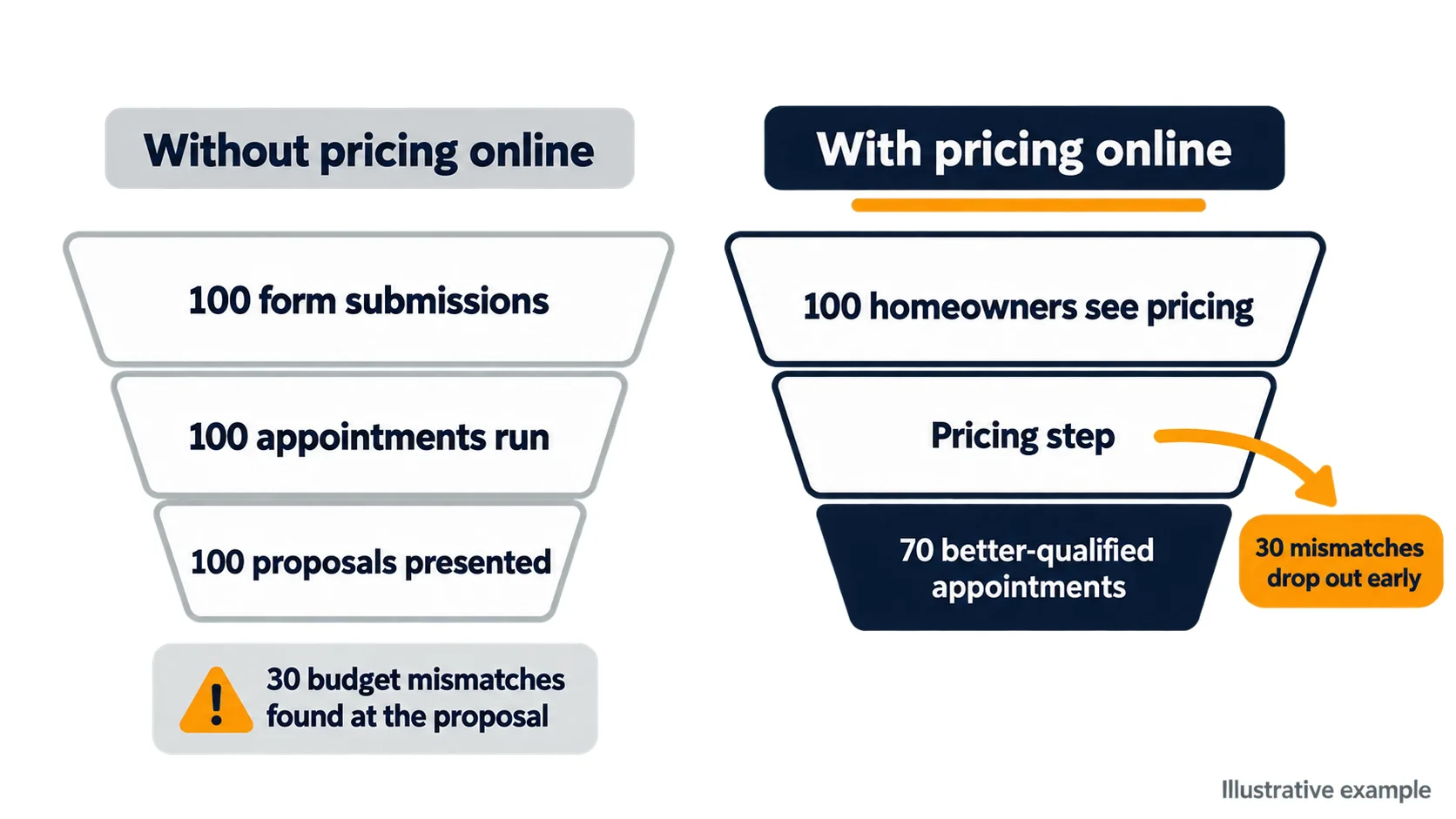
It also changes what "sticker shock" means. Pricing won't make a $15,000 system feel cheap. But there's a difference between a homeowner thinking "This is expensive," which is a normal sales conversation, and "I thought this would cost $5,000; there's no way I'm doing this," which is a qualification failure. Seeing pricing early gives homeowners time to research financing, look into rebates, and talk it over with a spouse before your advisor arrives.
Your sales team becomes more useful, not less. Instead of spending the first half of every appointment revealing numbers the website could have shown, advisors can focus on comfort problems, system design, equipment selection, and the homeowner's priorities. The website handles information; the salesperson handles expertise.
So don't judge online pricing only by whether form submissions go up. Track estimate completion rate, booking rate, qualified-appointment rate, close rate, average ticket, cost per sold job, and time spent on unqualified estimates.
What if my prices change frequently?
That's a legitimate concern. Equipment and material costs have moved significantly in recent years, including with the industry's shift to A2L refrigerant systems under the EPA's AIM Act rules. A pricing page that says "New systems from $8,000–$12,000" and hasn't been touched in three years stops being transparency and becomes misinformation.
Treat public pricing like your internal pricebook: review and update it on a schedule. If you use a dynamic online estimator, update the underlying equipment and pricing once instead of editing dozens of pages by hand.
So what should you actually put on your website?
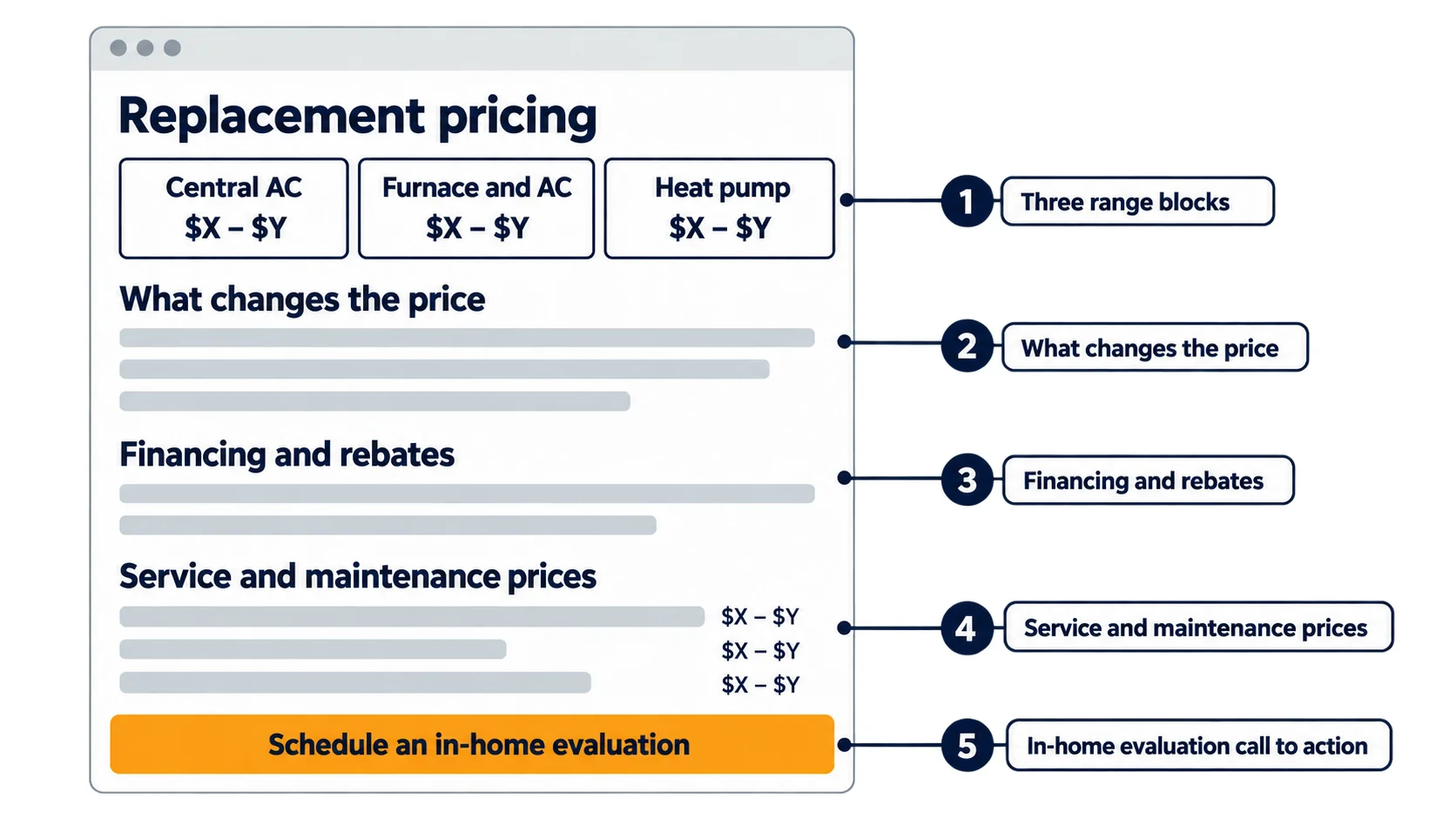
If you're not ready for an interactive estimator, start with realistic ranges. A replacement-pricing page might include:
Central AC replacement
Most complete AC replacements we install range from approximately $X to $Y.
Furnace and AC replacement
Complete furnace and air-conditioning systems generally range from approximately $X to $Y.
Heat pump replacement
Heat pump systems generally range from approximately $X to $Y, depending on capacity, efficiency, electrical requirements, and system configuration.
For each, explain what the range generally includes, what can change the price, financing availability, applicable rebates, and why an in-home evaluation is still required. Add your published service and maintenance prices alongside. That's already far more useful than "Call for a free estimate."
Going further: a preliminary estimate for each home
Static ranges are useful, but a 1,300-square-foot home and a 4,200-square-foot home shouldn't see the same number. With property-specific estimating, the homeowner enters their address and answers a few questions, and the system uses property data and contractor-defined equipment and pricing to produce preliminary options for that home:
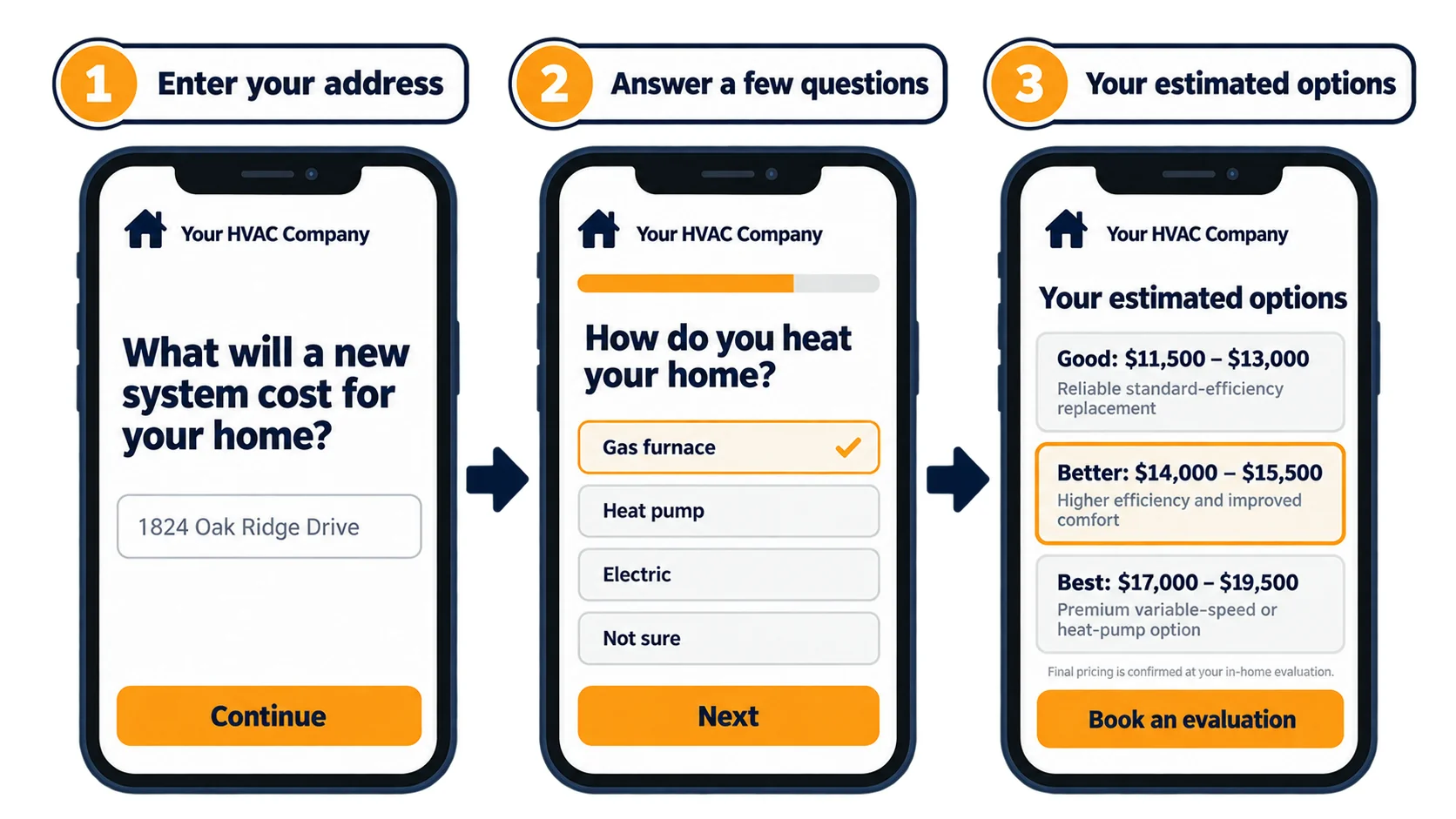
Now you're not just "putting prices on your website." You're answering the homeowner's real question: What might a replacement cost for my house?
Where Instant Estimate HQ fits
This is the problem Instant Estimate HQ is designed to solve. Instead of choosing between showing no pricing and publishing one generic price for everyone, contractors can give each homeowner a preliminary estimate based on their property.
The homeowner enters their address and answers a few questions. The system uses property information to estimate preliminary equipment sizing and matches the home with contractor-configured equipment options. The homeowner then sees good, better, and best options using pricing the contractor controls. Instant Estimate HQ captures the lead and can follow up automatically, helping move the homeowner toward booking an appointment.
It doesn't replace your load calculation or final in-home proposal. It answers the pricing question before the homeowner has to schedule one, which gives the homeowner more transparency and gives your sales team a better-informed lead.
See how Instant Estimate HQ works → or book a call.
The bottom line
HVAC contractors don't have to choose between hiding every price and selling complete systems online like refrigerators. There's a middle ground: give homeowners a realistic investment range, useful equipment choices, an explanation of what affects the price, a clear line between preliminary and final pricing, and an easy next step.
The contractor still verifies the home. The comfort advisor still provides expertise. The final proposal still reflects the actual installation. But the homeowner no longer has to schedule an appointment just to find out whether they're looking at a $7,000 project or a $17,000 one.
For many residential HVAC companies, that's what putting pricing online should mean.
Frequently Asked Questions
Should HVAC contractors put prices on their website?
For most residential contractors, yes: published service prices plus realistic ranges or preliminary estimates for replacements. You don't need one fixed price for every installation. See Should I publish exact replacement prices or price ranges?
Is an online HVAC estimate the same as a final quote?
No. A preliminary estimate gives pricing guidance based on the information available. The final proposal follows verification of system requirements and installation conditions. Make that distinction clear wherever you show pricing.
Won't competitors see my prices?
Yes, but consumer-facing ranges don't reveal your costs, markup, or margins, and competitors likely already know your general price level.
Can online pricing help pre-qualify leads?
Yes. A homeowner who sees a realistic range and still books an appointment has already passed an important qualification step.
Are there legal issues with advertising HVAC prices?
Possibly. Avoid "starting at" prices few customers can get, and remember that advertising a monthly payment generally triggers financing disclosure requirements under Regulation Z. Check with your financing partner and legal counsel.
What's the easiest way to start?
Publish your service and maintenance prices, add realistic ranges for common replacements, then consider good-better-best examples or a property-specific estimator as you get comfortable.