How HVAC Contractors Can Pre-Qualify Replacement Leads Before an In-Home Visit
Jay, InstantEstimateHQ

The short version: Most HVAC websites capture replacement leads but don't qualify them. Ask a handful of simple questions, show realistic pricing before the appointment, route each lead according to how ready it is, and judge the process by sold jobs, not appointments booked.
A lot of HVAC companies don't really qualify replacement leads. They capture them.
A homeowner fills out a form, someone from the office calls back, and if the homeowner says they're thinking about replacing the system, an estimate gets booked. Then the comfort advisor (your in-home salesperson) drives across town and starts working out whether there was a real opportunity in the first place.
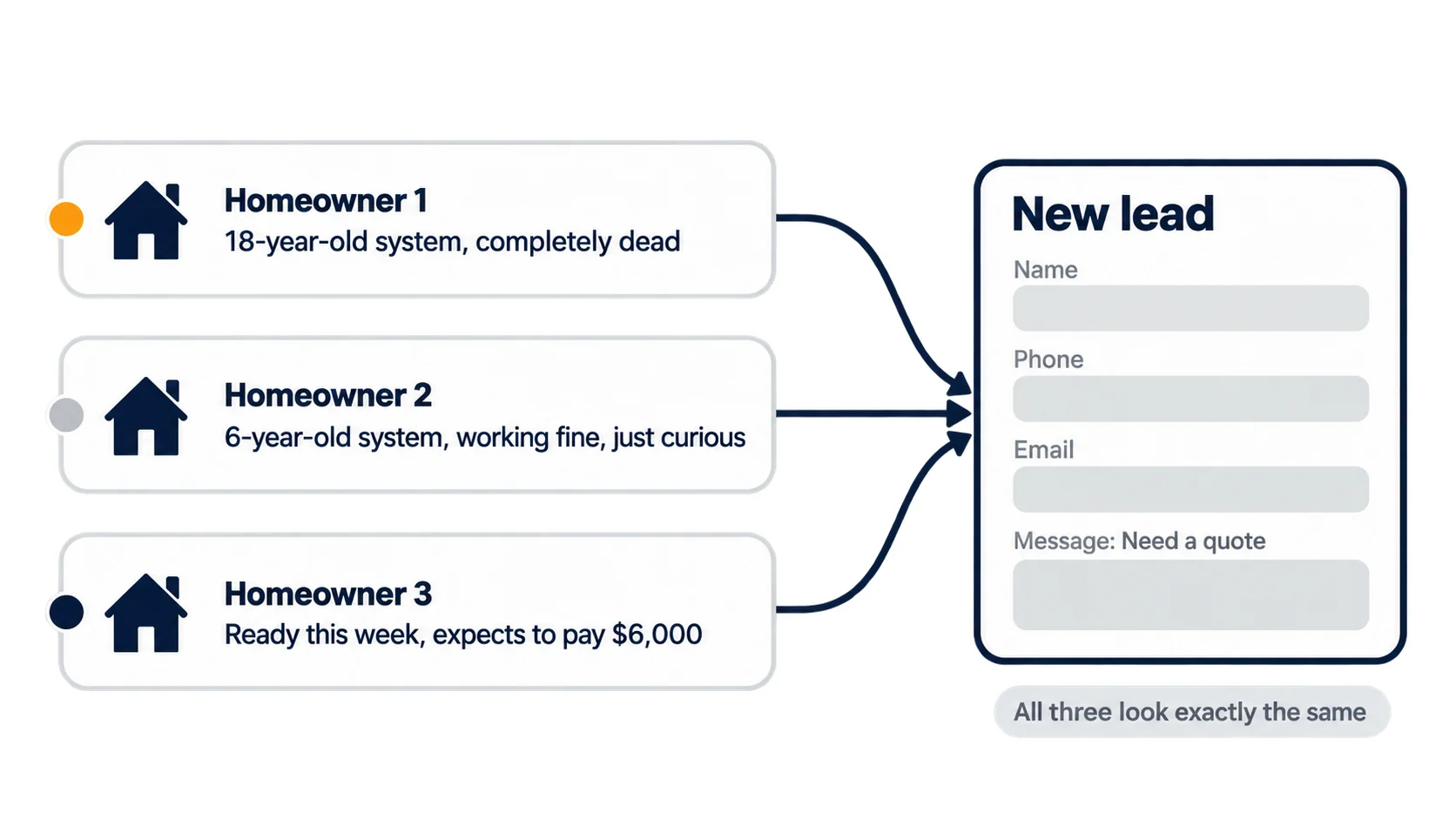
Maybe the system is 18 years old and completely dead. Maybe it's six years old, working fine, and the homeowner is curious what a heat pump might cost someday. Maybe they're serious about replacing it this week but think a complete system costs $6,000.
Those are three very different leads. On most HVAC websites, they look exactly the same:
Name. Phone number. Email. "Need a quote."
Pre-qualifying doesn't mean grilling homeowners before you'll agree to come out. It means learning enough before the appointment that your team knows what kind of opportunity it's walking into, and the homeowner knows enough about your pricing and process to decide whether the appointment makes sense.
If the first time you learn what the homeowner wants is when your comfort advisor arrives, you're learning too late. If the first time the homeowner learns what you charge is at the kitchen table, so are they.
What to ask before the appointment
You don't need a complicated lead-scoring system, and you don't need a 26-question form. That's not qualification; it's homework. Most homeowners don't know their furnace's BTU rating or whether their condenser is two-stage, so don't ask. A short set of questions they can actually answer tells you almost everything you need.
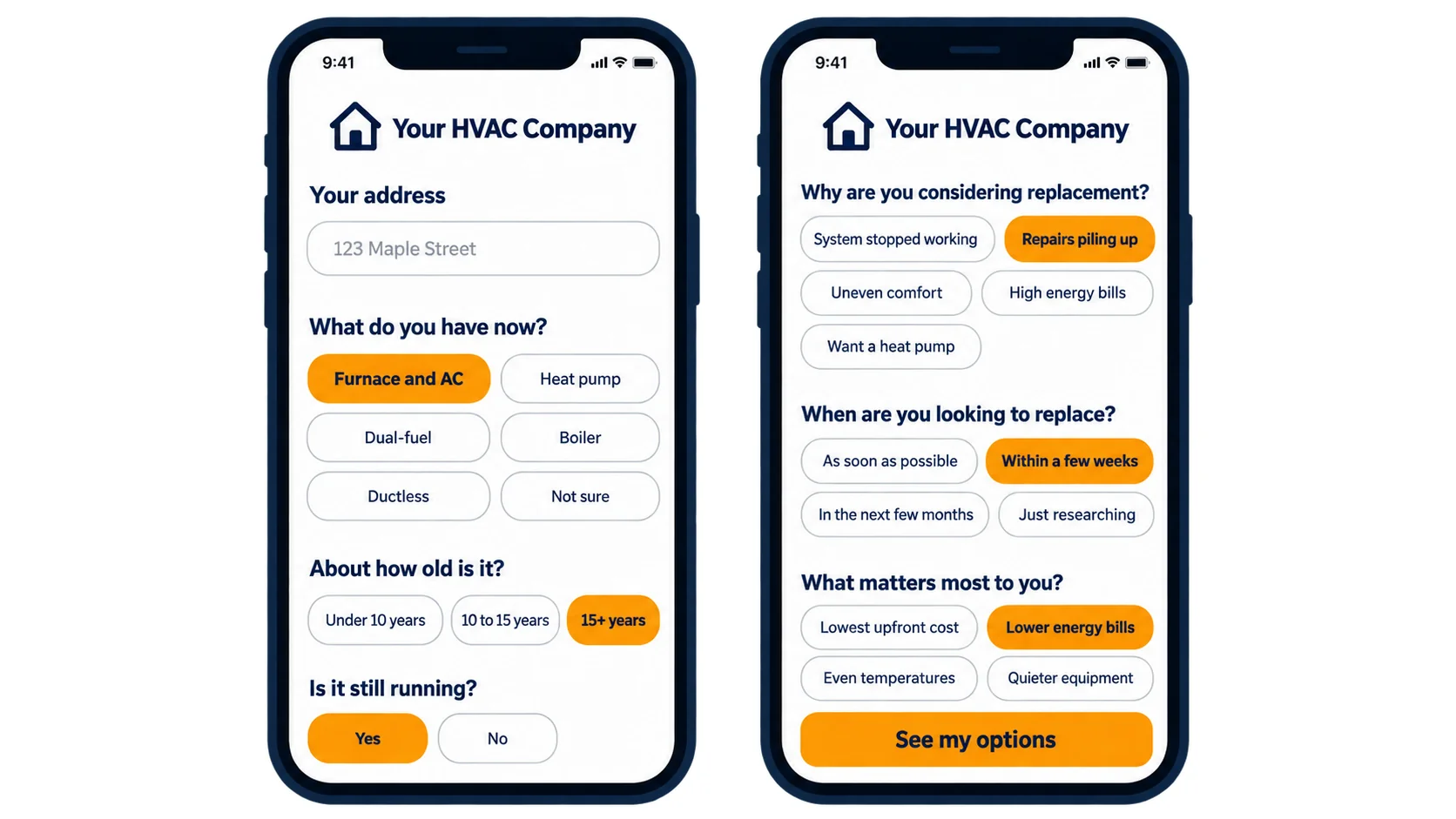
Start with the address. It ties the lead to a real home instead of an anonymous form submission. Depending on your tools, basic property details like square footage, year built, and number of stories can be pulled in automatically, so the homeowner doesn't have to type them. That data can't tell you about duct leakage, electrical capacity, or last year's addition, but it's enough to know whether you're talking about a 1,200-square-foot ranch or a 4,000-square-foot two-story, which is far more than a contact form gives you.
Ask about the current equipment. Skip the model and serial number. A simple choice works: furnace and AC, heat pump, dual-fuel, boiler, ductless, or not sure. Then ask roughly how old it is and whether it's still running.
Ask why they're considering replacement. This question tells you more than any other. The system might be dead, repairs might be piling up, one floor might never be comfortable, utility bills might be high, or they might be remodeling, getting off propane, or specifically interested in a heat pump. The job was never really "sell an HVAC system." It's to solve whatever made the homeowner start shopping.
Ask about timing. "When are you looking to replace the system?" with four options (as soon as possible, within a few weeks, in the next few months, just researching) is one of the easiest and most useful signals you can collect.
Ask what matters to them. Not which compressor technology they prefer, but what outcome they care about: lowest upfront cost, lower utility bills, more even temperatures, quieter equipment, better humidity control, switching to a heat pump, or "I'm not sure, show me my options."
Every question should either improve the estimate or help the comfort advisor. If it does neither, cut it.
Show pricing instead of asking for a budget
One of the most common qualification questions is also one of the weakest: What's your budget?
It makes sense from the contractor's side. From the homeowner's side, it's nearly impossible to answer. If they haven't bought a system in 12 or 15 years, they have no idea what one costs. They may pick "$5,000–$10,000" simply because that's what they assume replacement costs, not because $10,000 is their limit.
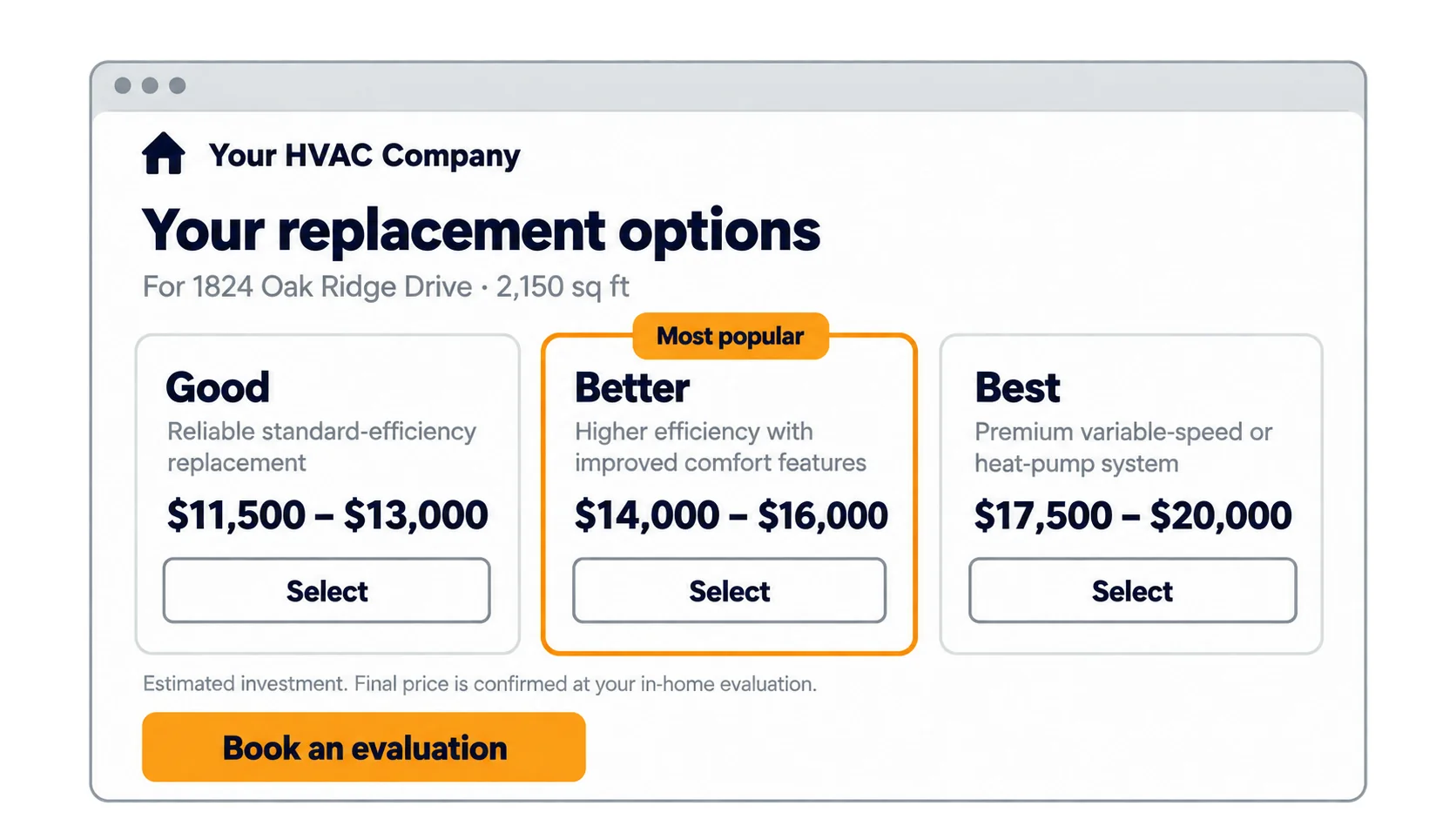
You get far better information by showing a realistic range and seeing what they do with it. For a typical full split-system replacement in a mid-cost market, that might look like:
| Option | What it is | Estimated investment |
|---|---|---|
| Good | Reliable standard-efficiency replacement | $11,500–$13,000 |
| Better | Higher efficiency with improved comfort features | $14,000–$16,000 |
| Best | Premium variable-speed or heat-pump system | $17,500–$20,000 |
Your ranges will depend on your market, equipment, margins, and typical installations. The principle doesn't change: the homeowner stops guessing what HVAC should cost and reacts to what you charge. If they see those numbers and keep going, you've learned something. If they decide they're not ready, you've learned something too, and you learned it before anyone spent an hour at the house.
It reduces sticker shock
You can't make a $15,000 replacement feel inexpensive, but you can make sure it isn't a surprise. "That's more than I was hoping to spend" is a normal sales conversation. "Wait, I thought this was going to cost five grand" means the two of you walked in with completely different expectations, and your comfort advisor spends the first 30 minutes recovering instead of talking about sizing, comfort, noise, efficiency, ductwork, warranties, and financing.
Good-better-best is a qualification tool, not just a sales tactic
Most contractors think of tiered options as a way to raise the average ticket. They also tell you something before the visit. If a homeowner spends time on the Better option and then books, your comfort advisor already knows they've seen your pricing, didn't leave when they saw it, probably aren't shopping for the cheapest possible system, and likely care about efficiency or comfort. That's a much better starting point than an email saying "New lead: John Smith. Interested in HVAC replacement."
An estimate isn't a quote, so say so
The usual worry is "What if we give them a number and then find something at the house?" That's what the word estimate is for. You're not promising that every 2,000-square-foot home costs exactly $14,327. You're establishing the right neighborhood and stating clearly that the final price depends on verifying sizing, ductwork, electrical, line sets, venting, equipment location, access, permits, and code requirements.
There's nothing misleading about this:
"Based on the information we have, your replacement will likely fall between $13,000 and $16,000. We'll confirm equipment sizing and installation requirements during the in-home evaluation."
It's far more useful than "We can't tell you anything until we get there."
Price shoppers aren't the same as tire kickers
"Tire kicker" often gets applied to anyone who asks about price early. That's too broad. Anyone spending $15,000 to $20,000 on their home is going to compare options, and a homeowner collecting three estimates can be a very strong opportunity.
The real question is whether there's buying intent behind the shopping. A homeowner with a failed 16-year-old system getting three proposals this week is shopping because they're buying. Someone with a perfectly good system collecting prices "just in case" is researching. Keep both leads, but don't treat them the same way.
And don't hide your pricing hoping it will prevent comparison shopping. It won't. It just pushes the comparison later in the process, after you've already paid for the appointment.
Route each lead according to how ready it is
The point of qualification isn't to label leads "good" or "bad." It's to decide what should happen next. You don't need an enterprise lead-scoring system for that; you just need to stop treating every form submission as if it means the same thing.
| What you know | What should happen next |
|---|---|
| No heating or cooling, older system, wants it done now | Call immediately and offer the earliest available appointment |
| Working system, replacing within a few months | Offer an appointment on their timeline; send options and financing info |
| Reviewed a specific option, left at the booking step | Personal follow-up call or text from the office |
| Just researching, no near-term timeline | Automated email or text follow-up with education and a booking link |
| Entered an address and left immediately | Light-touch follow-up at most |
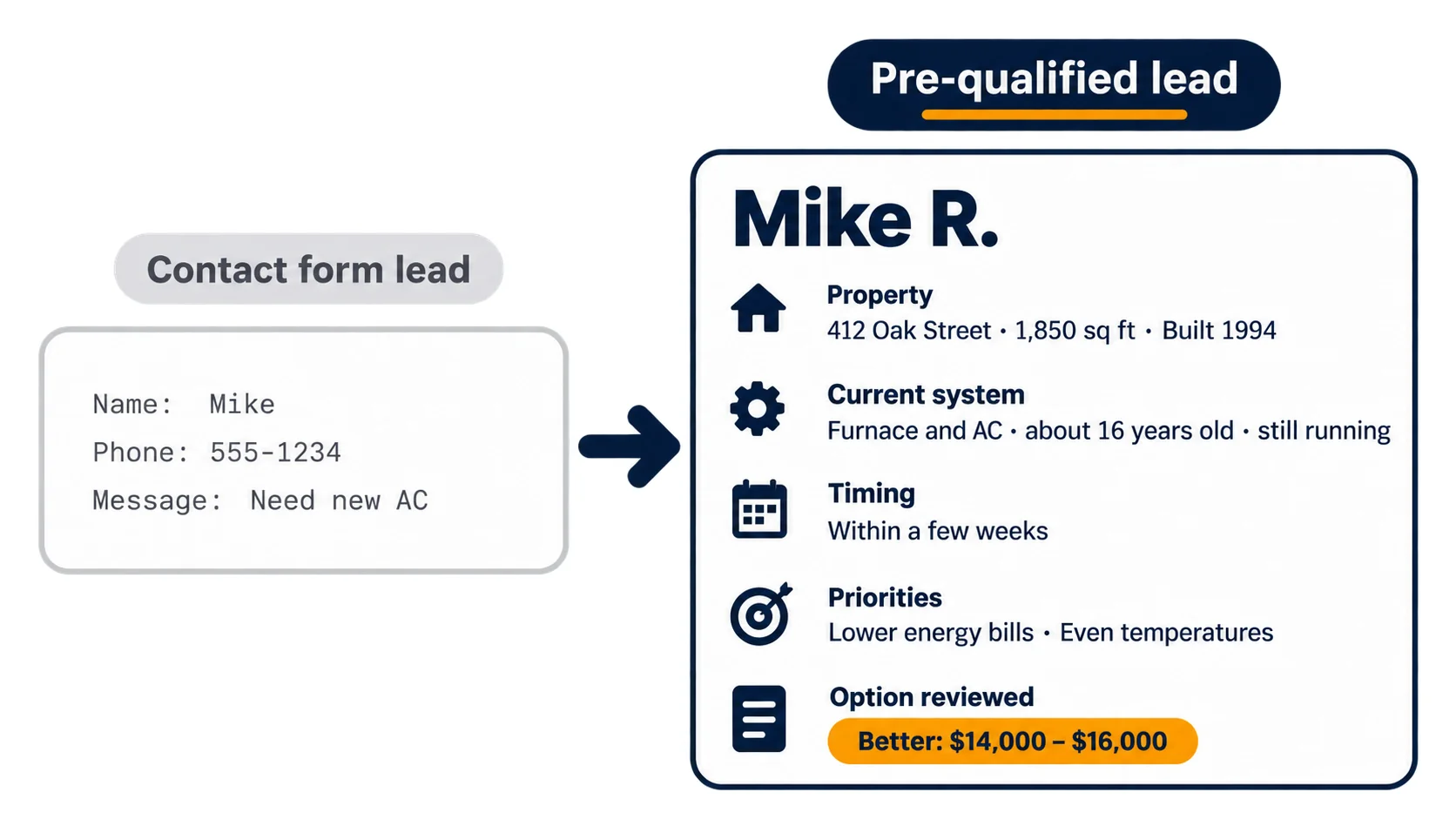
This also changes the first phone call. Instead of "Hi, you filled out our form. What can we help you with?", your team can open with "I saw you're looking at replacing the system at your home on Oak Street and were interested in the higher-efficiency option. I wanted to answer any questions and see if you'd like us to come out and verify everything."
Keep the leads that aren't ready
Pre-qualification isn't a digital bouncer. Plenty of good future customers aren't ready for an appointment: they're waiting for shoulder season, talking it over with a spouse, sorting out financing, watching for a rebate, or getting one more estimate. The useful part is that now you know. Put them into follow-up with financing information, heat-pump explainers, and a booking link for when they're ready, rather than forcing an appointment or losing them.
This matters more than it sounds, because homeowners research at 10:30 at night and on Sunday mornings. If qualification depends on a CSR calling back during business hours, it stops until your office opens. Your website can do the early work at any hour so your team starts the conversation further along.
The objections you'll hear
"Competitors will see our pricing." They can already get it by calling you or asking any homeowner you've given an estimate, since people share proposals. A range per tier reveals far less than a line-item proposal on a kitchen table, and whatever you'd gain by hiding it, you lose in appointments with homeowners who were never going to pay your price.
"People will anchor to the bottom of the range." Some will. But explaining why the final price came in $1,500 higher because of a line-set replacement is an easy conversation. Going from nothing to $15,000 is not. If nearly everyone ends up well above your stated range, the range is wrong, and it should be fixed rather than hidden.
"Our process depends on building value in person before price comes up." Your comfort advisor still builds value in person. The difference is that a homeowner who already knows the rough number spends the visit listening to why your system is worth it instead of absorbing the shock. Price comes up either way; the only question is whether it happens before or after your advisor's afternoon is committed.
"Our jobs vary too much for ranges to mean anything." Ranges can be narrowed by system type and home size. Even a wide range tells a homeowner expecting $6,000 that they're in the wrong neighborhood, and that's often the most important thing to establish.
Judge it by sold jobs, not booked appointments
This is the part contractors often don't like at first: if you show pricing earlier and ask better questions, your booked estimates may go down. That's not automatically bad.
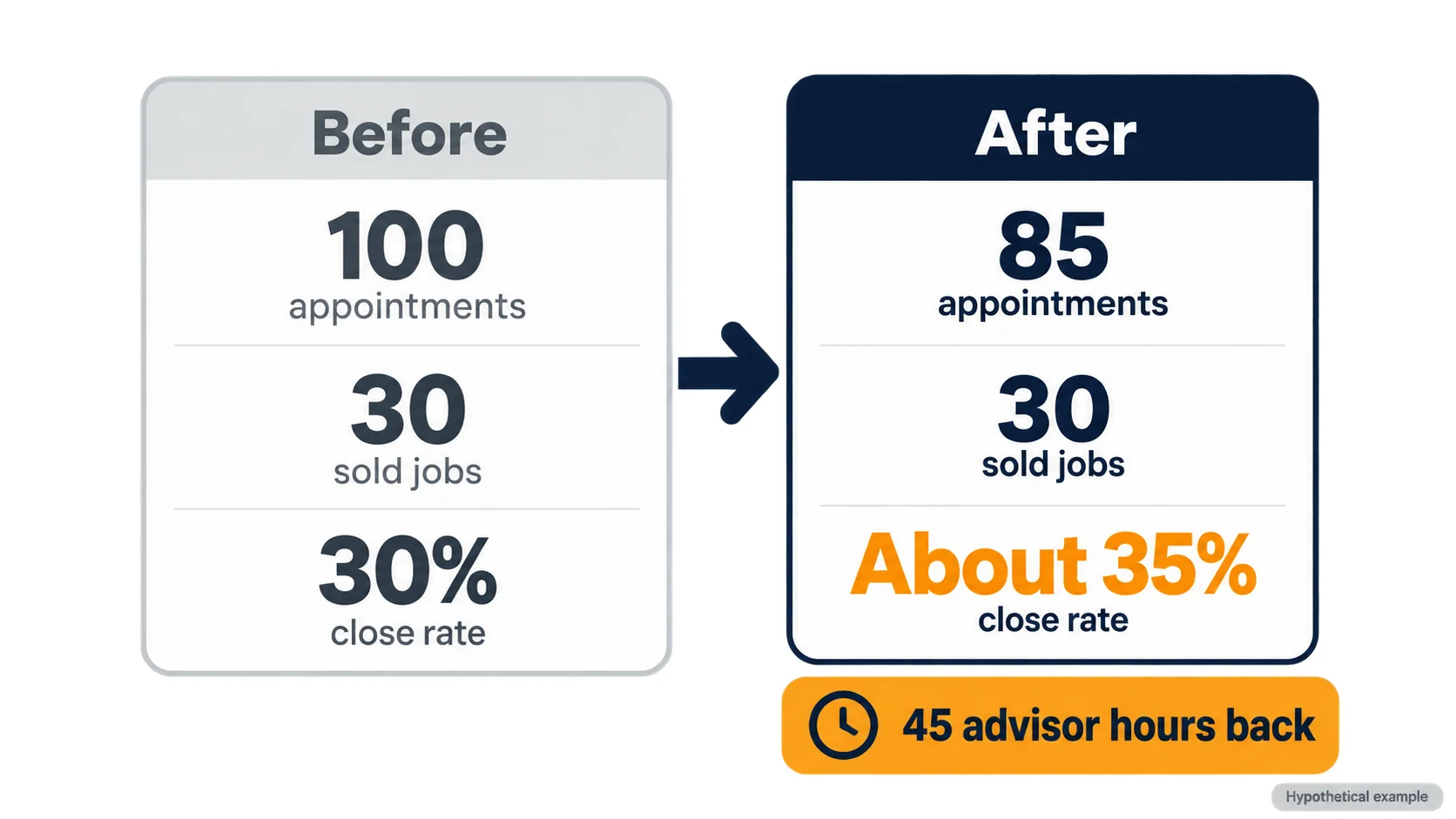
Say you run 100 replacement appointments a month, and 20 of those homeowners had price expectations that were never going to meet yours. Your team still drove to all 20 houses, built all 20 proposals, and counted all 20 in the close rate.
Now suppose better qualification brings that down to 85 appointments with the same 30 sold jobs. Your close rate rises from 30% to about 35%. If each appointment costs your comfort advisor roughly three hours including drive time and proposal work, that's around 45 hours a month back, time that can go to the homeowners who are ready to buy.
Track what happens after the appointment, not just before it:
- appointment-to-sale rate
- average replacement ticket
- cancellations and no-shows
- comfort advisor time per sold job
- how often jobs are lost mainly because of price expectations
It's also worth breaking close rate down by lead type: referral versus paid, existing versus new customers, emergency versus planned replacement, different marketing channels, and, most telling, leads that saw pricing before the visit versus leads that didn't. A falling company-wide close rate can look like a sales problem when it's actually a lead problem. Your advisors may be closing serious opportunities at a healthy rate while running too many appointments that were never serious to begin with. That calls for a very different fix than "our salespeople need more training."
A simple version you can set up this week
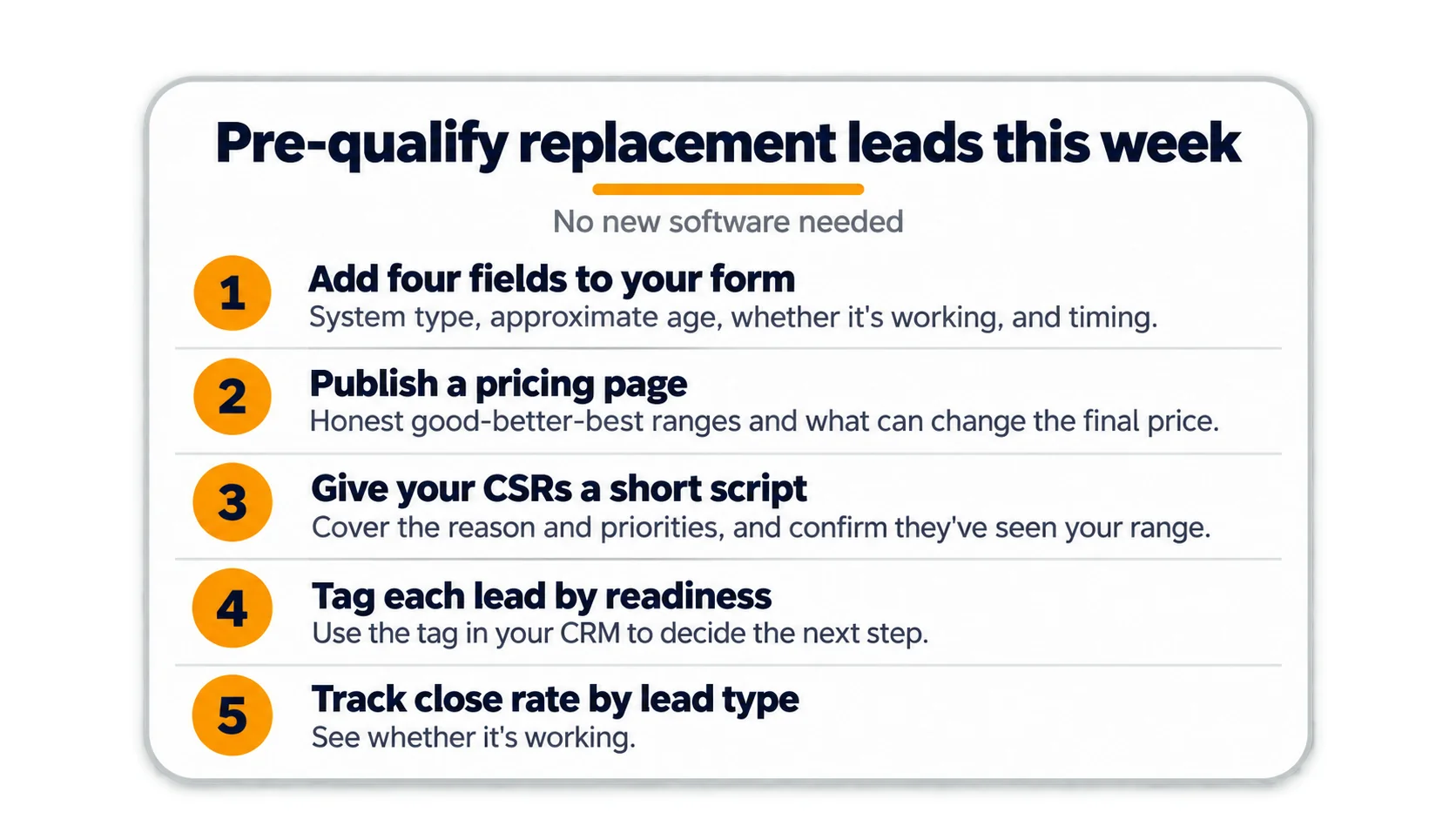
You don't need new software to start. A basic version looks like this:
- Add four fields to your existing form: system type, approximate age, whether it's working, and timing.
- Publish a pricing page with honest good-better-best ranges and a clear note about what can change the final price.
- Give your CSRs a short script that covers the reason for replacement and what matters most to the homeowner, and that confirms they've seen your pricing range before booking.
- Tag each lead by readiness in your CRM and use the routing table above to decide the next step.
- Start tracking close rate by lead type so you can see whether it's working.
That alone will tell you far more before the visit than you know today. The limitation is that it's manual: the homeowner sees a general range rather than options for their specific home, and your team has to piece the lead together from separate places.
Where Instant Estimate HQ fits
That gap is why I co-founded Instant Estimate HQ. Most HVAC websites jump straight from "I'm thinking about replacing my system" to "Give us your contact information and we'll call you," with nothing in between.
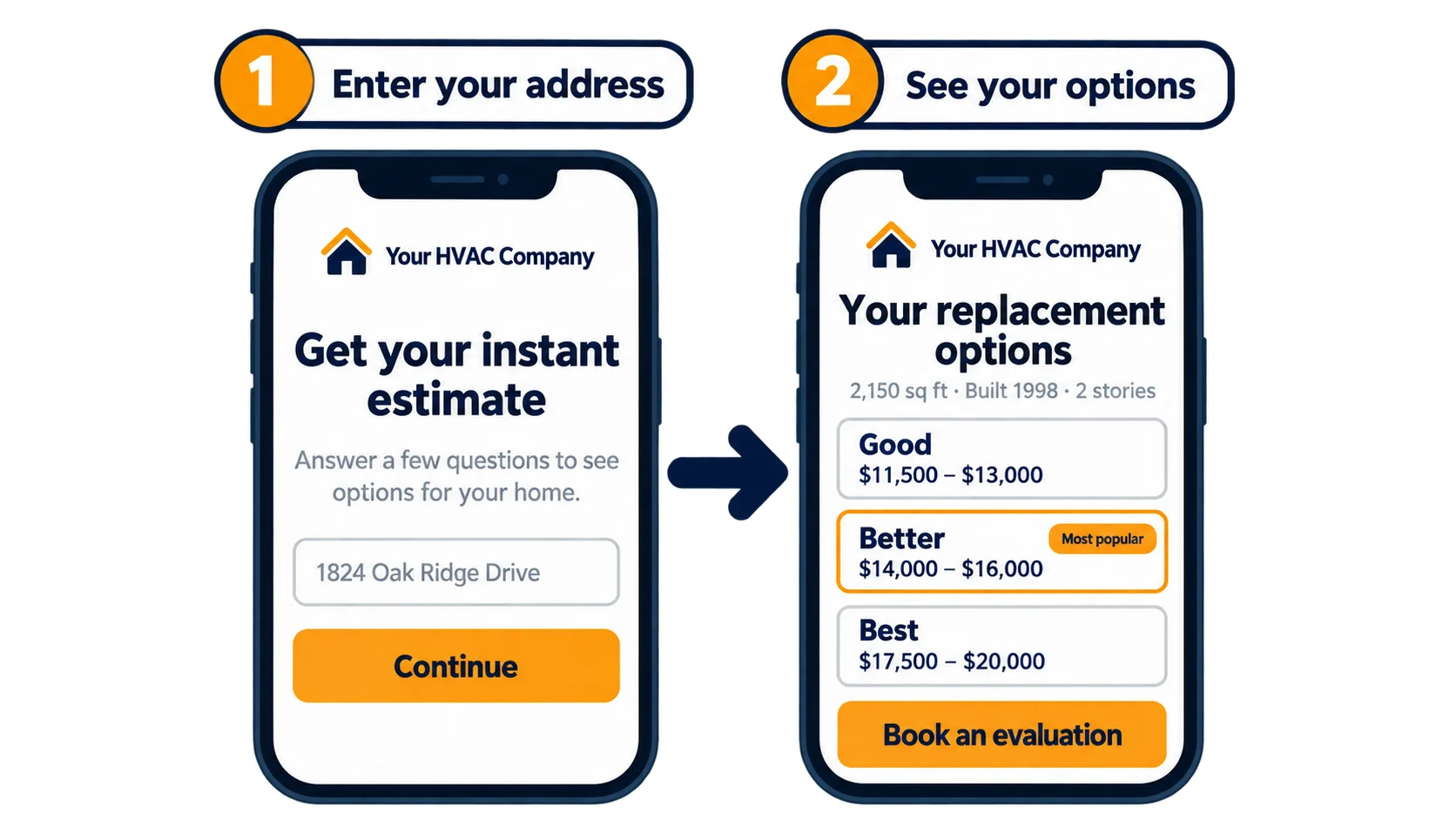
With Instant Estimate HQ, the homeowner enters their address and answers a few questions about the home and what they're looking for. The system combines available property data with your configured equipment and pricing to produce good-better-best replacement options for that specific home, with a realistic investment range for each. The homeowner can book an evaluation, ask a question, request financing, or keep researching, and your team receives a lead record with the property details, system information, timing, priorities, and the options they reviewed.
No software can predict who is guaranteed to buy. The goal is simpler: the homeowner knows roughly what you sell and what it costs, and your team knows more about the homeowner, before anyone gets in the truck.
See a live sample estimate → or book a call.
Frequently asked questions
How do I stop sending comfort advisors to tire kickers?
Look for real intent rather than just a filled-out form: a genuine replacement need, a near-term timeline, engagement with your options and pricing, and a clear choice to book. Don't reject someone just because they're comparing contractors. Homeowners getting multiple estimates are often serious buyers.
How do I prevent sticker shock on an HVAC replacement?
Show realistic pricing before the appointment. You don't have to promise a final installed price; a preliminary range or good-better-best options, with a clear explanation of what can change the final number, is enough to set accurate expectations.
What information should I collect before booking an HVAC estimate?
At minimum: the property address, current system type, approximate age, whether it's working, why they're considering replacement, their timing, and what matters most to them. If you can, let them review preliminary options and pricing too.
Should I ask homeowners what their budget is?
Usually not as your main qualification question. Most homeowners don't know what replacement costs, so their answer reflects a guess rather than a limit. Showing realistic options and seeing whether they continue tells you much more.
What should I do with leads that aren't ready for an appointment?
Keep them in follow-up by email, text, or your CRM, and make it easy to book when their timing changes. You don't need to send a comfort advisor out just to keep the lead alive.
Will pre-qualifying leads increase my close rate?
It usually improves the quality of the appointments your team runs, which tends to improve close rate. But pricing, financing, sales execution, lead source, and follow-up all matter as well, so judge the process by sold jobs and sales efficiency rather than appointments booked.
The bottom line
Most HVAC contractors don't need a more complicated qualification process. They need to move a few important conversations earlier: what the homeowner needs, when they want to do it, what their options are, and roughly what replacement will cost.
The in-home visit still matters. Your comfort advisor still needs to verify sizing, inspect ductwork and access, understand comfort problems, and help the homeowner choose the right system. It just shouldn't be the first time either side learns anything useful.