Why Your HVAC Website Isn't Bringing In Enough Replacement Leads
Jay, InstantEstimateHQ
Your SEO report looks pretty good.
Traffic is growing. You're showing up for plenty of local HVAC searches. Your Google Ads are sending people to the right pages. You might even be getting a steady flow of calls for repairs, tune-ups, and maintenance plans.
But the install and replacement leads are still lagging.
This is something I see with a lot of HVAC websites. They do a decent job of bringing people in, but when a homeowner starts looking into a $12,000, $18,000, or $25,000 system replacement, there isn't much on the site to help them move forward.
Usually, their only options are to call the office or fill out the same generic contact form someone would use for a clogged condensate drain.
Think about the homeowner whose 15-year-old AC just died. They're about to spend a significant amount of money, they're probably looking at a few different contractors, and they have a lot of questions before they're comfortable inviting someone into their home.
How much should they expect to spend? What replacement options make sense for their house? Can they finance the installation? How quickly can you get the work done? And what gives them confidence that your company will do the job right?
These are all things they're thinking about while browsing your website, often before they're ready to speak with anyone.
If getting even a rough idea of pricing, exploring their options, or learning about financing requires them to schedule an appointment first, you're making it pretty easy for them to hit the back button and check out the next contractor.
And that's how an HVAC company can have solid traffic numbers, good local rankings, and a healthy advertising budget while still leaving a lot of replacement opportunities on the table.
A quick self-audit before you read further
Suppose 1,000 people a month reach your replacement-related pages and 20 become replacement leads. Before buying another 500 visitors, I'd want to know what happened to the other 980.
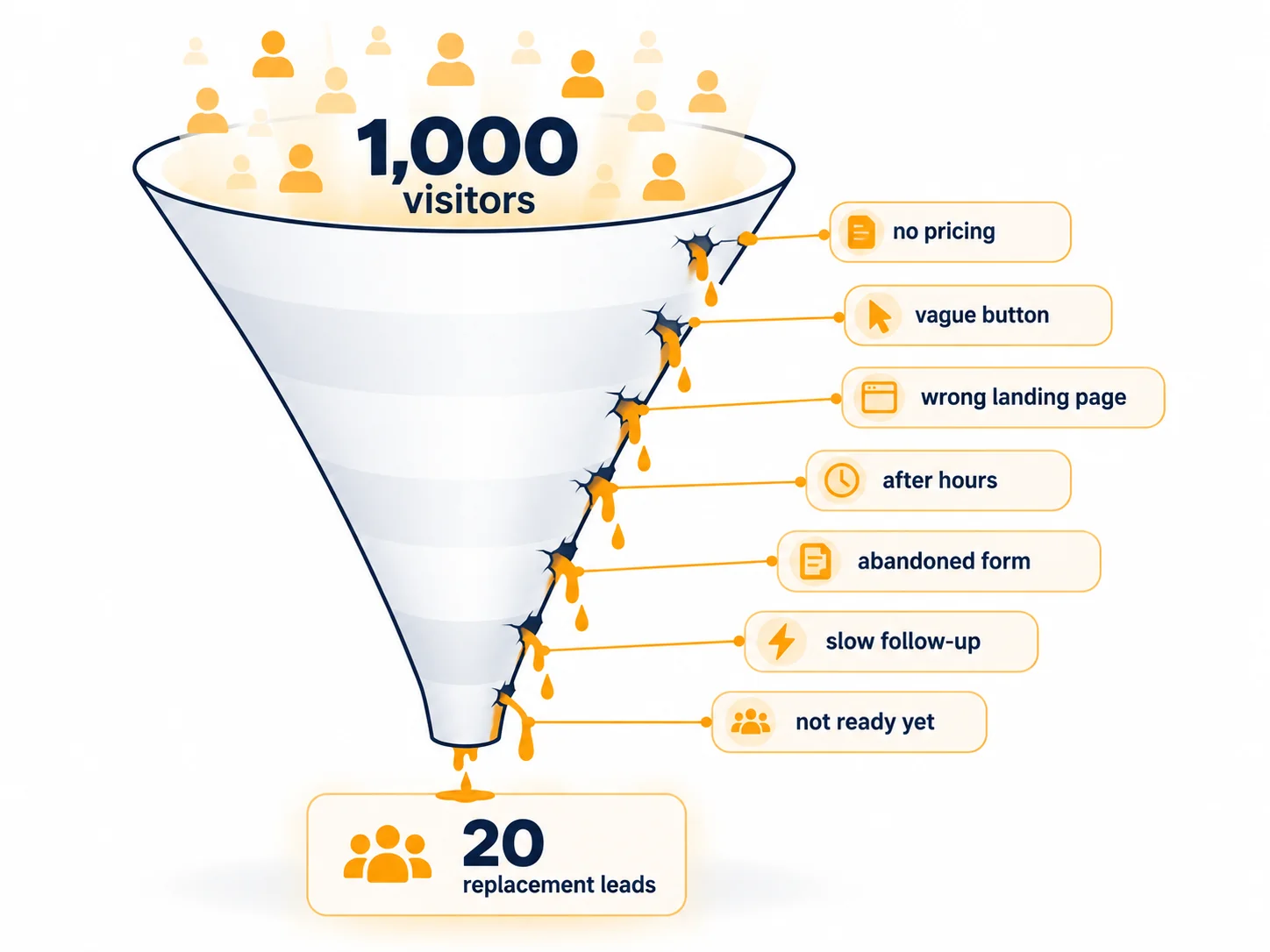
Some were never serious buyers. Fine. But ask yourself:
- How many wanted pricing and couldn't find it?
- How many landed on a page with one vague "Request a Quote" button?
- How many clicked an ad and landed on the homepage?
- How many visited at night and had no way to keep moving?
- How many opened the form and abandoned it?
- How many submitted and didn't get contacted quickly?
- How many were interested but not ready for an appointment, so you never captured them at all?
If you can't answer most of those, that's the first finding. The rest of this article walks through each leak in the order a homeowner hits them, from the click to the follow-up call.
First, make sure you're getting the right traffic
Not all HVAC traffic is equally useful.
A website can generate thousands of visits from searches like "why is my AC making noise," "how often should I change my furnace filter," or "furnace tune-up near me." There's nothing wrong with that traffic. But it isn't the same as:
- AC replacement cost
- new HVAC system cost
- heat pump installation near me
- replace furnace and AC
- high-efficiency HVAC replacement
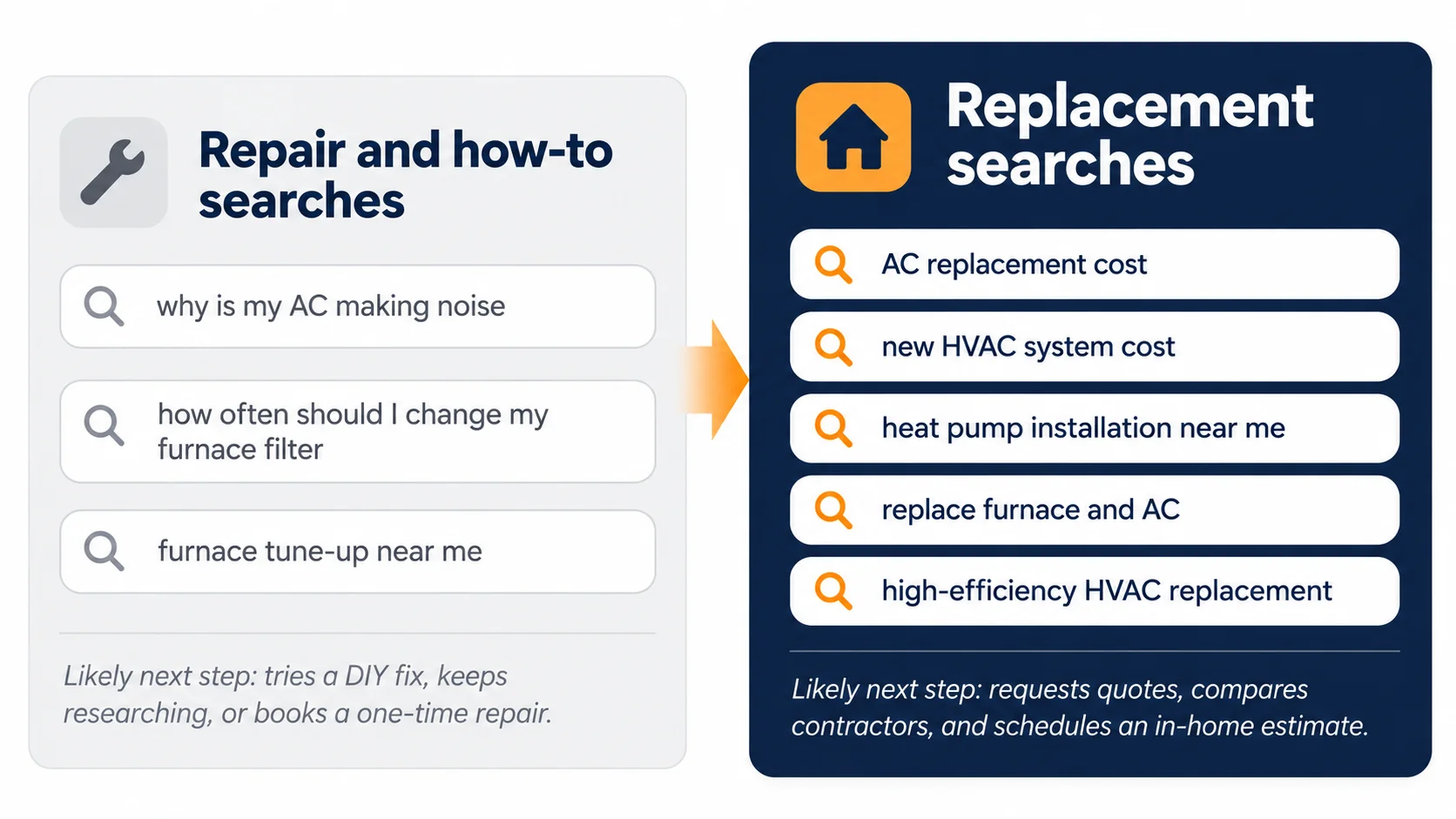
Someone searching for replacement cost is much further into a buying decision than someone trying to figure out why a vent is blowing warm air. ACHR NEWS's 2026 guide to HVAC Google Ads makes the same distinction, recommending that contractors separate emergency repair searches from installation searches like "new HVAC cost" and "heat pump installation," and bid on them differently.
So look at your analytics before blaming the website. If most of your organic traffic lands on repair articles and tune-up pages, the real problem may be that you aren't attracting enough replacement intent in the first place.
But if homeowners are already reaching your replacement pages and not contacting you, keep reading. That's where the more expensive leak usually is.
Stop sending replacement traffic to the homepage
The first leak often happens before the homeowner reads a word.
A contractor runs an ad for AC Replacement Financing and sends the visitor to the homepage. Or runs Heat Pump Installation and sends them to a generic services page listing furnaces, boilers, plumbing, generators, IAQ, maintenance, and commercial work.
You paid for specific intent. Give it a specific landing page.
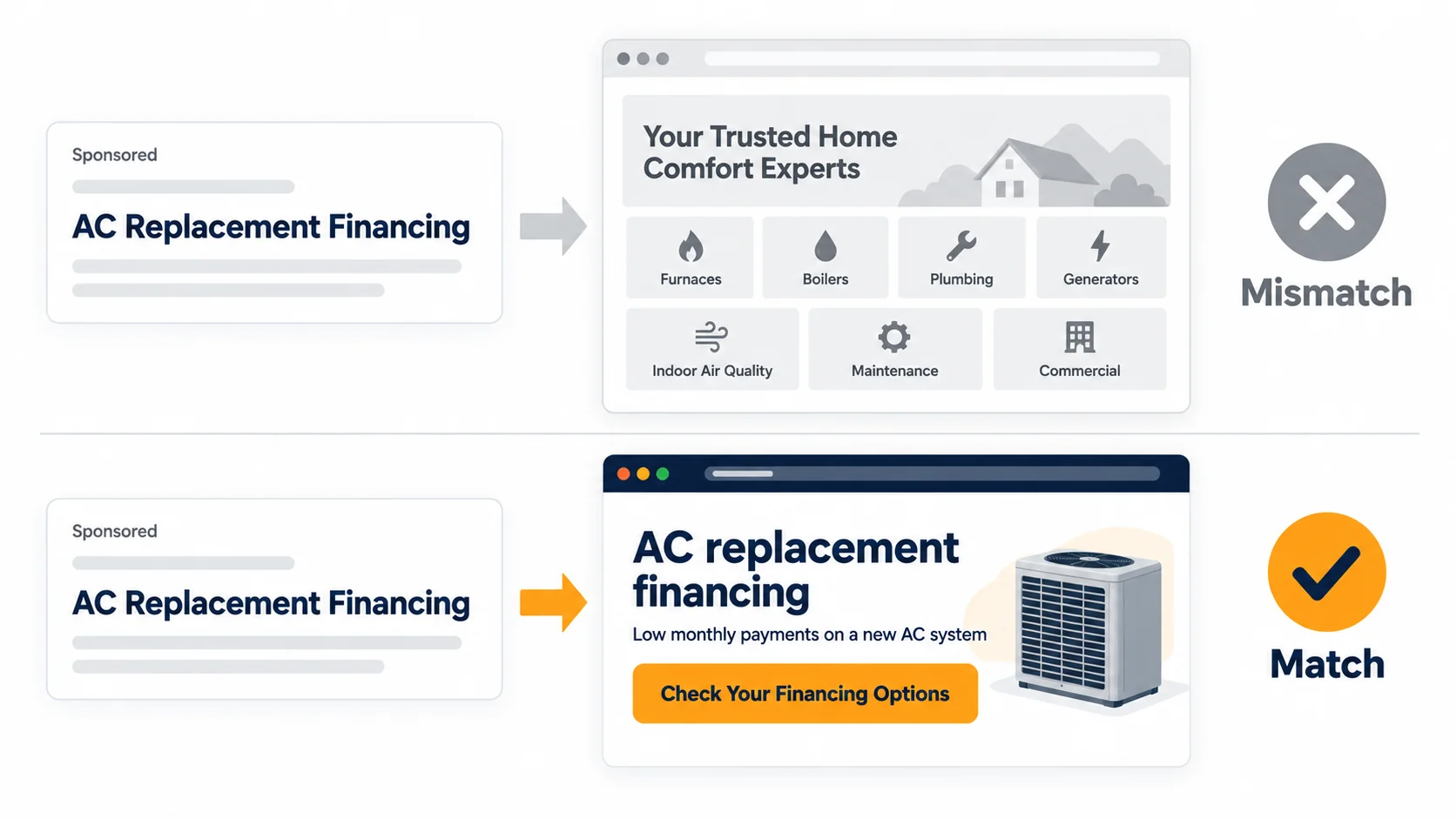
A replacement landing page should make it obvious within a few seconds that the homeowner is in the right place. If the ad is about heat pumps, show heat pumps. If the search is about AC replacement cost, talk about AC replacement cost. If you're advertising financing, don't make the visitor hunt through the footer to find it.
The same applies to organic search. Build dedicated pages for the major systems you actually sell, so each high-intent search has somewhere specific to land.
Give replacement shoppers their own path
Go look at the average contractor homepage. You'll probably find some version of Call Today, Schedule Service, Request an Estimate, and Contact Us.
Those aren't bad calls to action. They just don't tell a replacement shopper very much. "Schedule Service" sounds like a repair call. "Contact Us" is administrative. And "Request an Estimate" really means give us your information and we'll tell you something later. That's not much of an offer.
A homeowner considering replacement is trying to answer questions before deciding whether an appointment is worth their time. How much might this cost? Should I repair or replace? What does a heat pump cost compared with another furnace and AC? Do you offer financing? How soon could this happen?
A contact form answers none of those. It asks the homeowner to make the next commitment first, which is backwards.
You don't need to rebuild the entire website. Start by separating service from replacement, and make Replacement an obvious choice in the navigation.
Someone with no cooling at 3 p.m. in July should be able to hit Schedule Repair and get moving. Someone researching a new system should have an equally obvious path, such as Get Replacement Pricing, See Your System Options, or See What a New System Could Cost.
That distinction alone makes the site easier to understand. It also lets you build the replacement path around replacement questions instead of forcing a $20,000 buyer through the same three-field form as a $189 service call.
Here's what that can look like at the top of a replacement page:
![Before and after versions of an HVAC replacement page header. Before: "Quality Heating & Cooling Solutions" with generic copy and a Request an Estimate button. After: "Replacing Your AC or Furnace in [City]?", a typical $11,000–$19,000 price range, preliminary pricing in about two minutes with no appointment, financing from $XXX/month, a See My System Options button and a call option](/images/blog/hvac-replacement-page-before-after.webp)
The second version answers the price question, tells the homeowner what happens when they click, and still leaves room for people who want to call.
You're probably hiding the thing they came for
Price.
This is uncomfortable for a lot of HVAC contractors, but it keeps coming up because homeowners care about it. In a 2024 ACHR NEWS/myCLEARopinion study, 70% of homeowners surveyed said they were more likely to call an HVAC contractor that was transparent about pricing online. Only 31% of the contractors surveyed said they featured pricing on their websites.
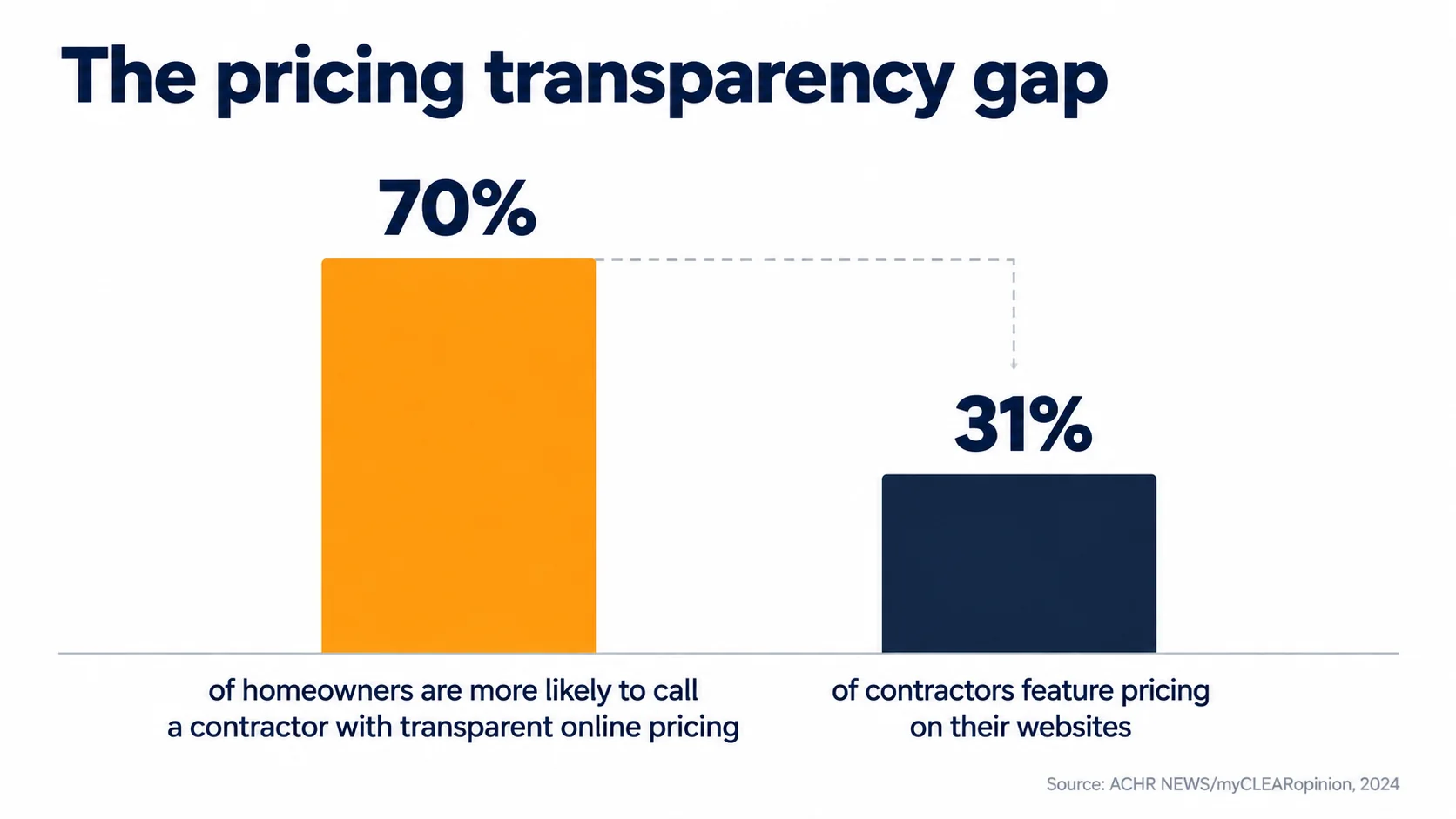
That doesn't mean putting "Complete HVAC replacement: $14,482" on the homepage. Every contractor knows why that would be a problem. You haven't seen the ductwork, you don't know the electrical situation, you haven't confirmed sizing, and you don't know whether the air handler is in a wide-open basement or buried behind Christmas decorations in a 125-degree attic.
But "we can't give a final price online" and "we can't tell you anything about price" are two very different positions.
If most of your replacements run from $11,000 to $19,000, there's nothing wrong with saying so and explaining what affects the final number. You can go further and show good-better-best examples, or give the homeowner a preliminary estimate based on their property. The point is to give them enough information to decide whether they want to continue.
"But what about…"
Contractors who hold back on pricing usually have more than ductwork on their minds. Three objections come up most often.
"My competitors will see my prices." They can already get them. Homeowners share proposals, and any competitor who wants your numbers can call for an estimate. A published range or a preliminary estimate isn't your final proposal, so it doesn't give away your margin or your sales process.
"I'll get flooded with price shoppers." You're getting price shoppers now. You just don't find out until your comfort advisor has driven across town. A realistic range up front tends to filter the other way: homeowners who see the likely investment and still ask for an appointment are more serious, not less. ACHR NEWS has reported the same pattern.
"My comfort advisors want to control the conversation." They still will. Preliminary pricing doesn't replace the in-home evaluation; it sets it up. The advisor walks in knowing the homeowner has seen a range, has picked a tier they're leaning toward, and hasn't been scared off by it. That's a better starting point than a cold sticker-shock moment at the kitchen table.
I've gone deeper on this in Should HVAC Contractors Put Prices on Their Website? But from a conversion standpoint, the issue is simple: if a homeowner came to your site to understand replacement cost and your competitor answers the question while you say "call us," you've given them a reason to leave.
Offer something connected to the decision they're making
HVAC marketing borrowed the phrase "lead magnet" from the rest of digital marketing, which sometimes leads to strange ideas.
You don't need a 17-page PDF called The Ultimate Homeowner's Guide to HVAC Efficiency. A replacement shopper with a dead compressor isn't looking for homework.
If you're trying to capture high-intent replacement traffic, offer something tied to the decision they're already making: a replacement cost range, a property-specific estimate, a good-better-best comparison, a financing calculator, a heat-pump-versus-furnace comparison, or local rebate information.
The closer the offer is to "What would replacing the system in my house look like?", the more naturally it fits the visitor's intent. For a contractor focused on installs, an online estimate is usually a much stronger offer than a downloadable checklist, because the homeowner gets the information they were already looking for and you get a real replacement opportunity instead of an anonymous visit.
Replace adjectives with evidence
A lot of contractor websites say essentially the same thing: quality heating and cooling solutions, experienced technicians, your comfort is our priority. None of that is harmful. None of it gives a homeowner a reason to choose you, either.
A replacement page needs specifics:
- The brands you actually install and the types of systems you sell.
- Heat pumps, if they're a real part of your business.
- Financing, explained in plain terms, where buyers can see it.
- What happens during the in-home evaluation.
- How long a typical changeout takes.
- Warranties, in plain language.
- What good-better-best actually means, if that's how you sell.
- Real installation photos, not stock images.
- Reviews from replacement customers, not just someone praising a quick capacitor fix.
- Any Manual J, commissioning, or airflow testing you do that separates you from a cheap changeout, explained in homeowner language.
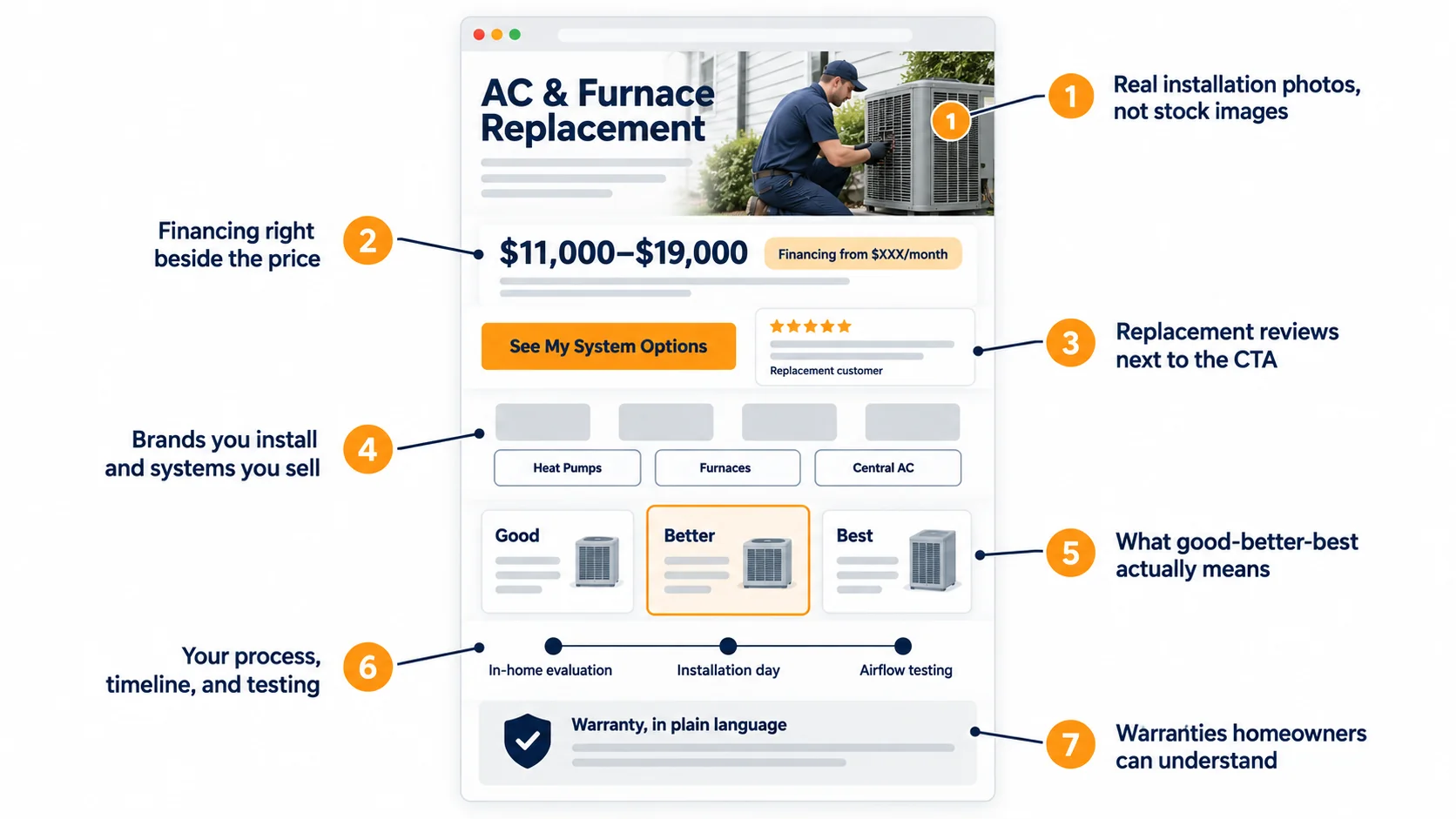
Reviews matter especially here. In a 2024 ACHR NEWS homeowner study, 91% of respondents rated online reviews as an important factor when choosing an HVAC contractor.
Don't bury that proof on an About page nobody visits. Put it next to the replacement decision.
Generic forms produce generic leads
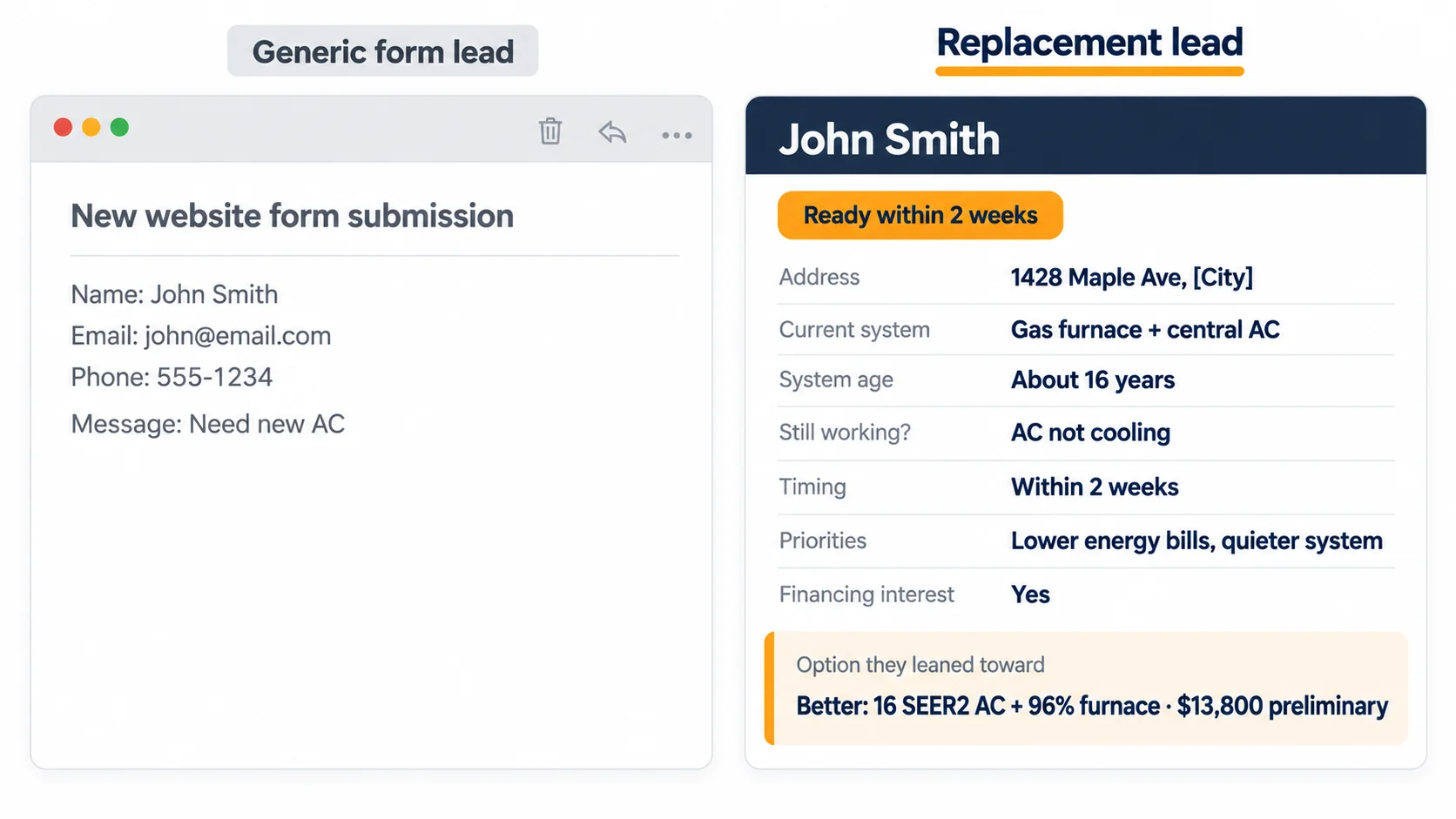
Here's what most HVAC websites send the office:
John Smith · john@email.com · 555-1234
Message: Need new AC
Now your CSR has to start from scratch. How old is the system? Is it still working? Is John looking for AC only, or furnace and AC? Is he interested in a heat pump? Is he replacing this week or six months from now? Has he seen any pricing?
For replacement traffic, collect information that makes the eventual conversation better. Not 30 questions, just useful ones: address, current system, approximate age, whether it's working, replacement timing, and a few priorities.
Then give something back. If you can show relevant equipment options and preliminary pricing based on what the homeowner entered, you aren't simply collecting a lead anymore. You're starting the sales process, and by the time someone from your office follows up, the conversation already has context.
Don't make a homeowner wait until Monday morning
HVAC websites stay open even when HVAC offices don't. That sounds obvious until you look at how most sites work after 5 p.m.
A homeowner can browse the site, read service pages, and look at reviews. When they're finally ready to act, the site says fill out this form and we'll contact you, and nothing happens until morning.
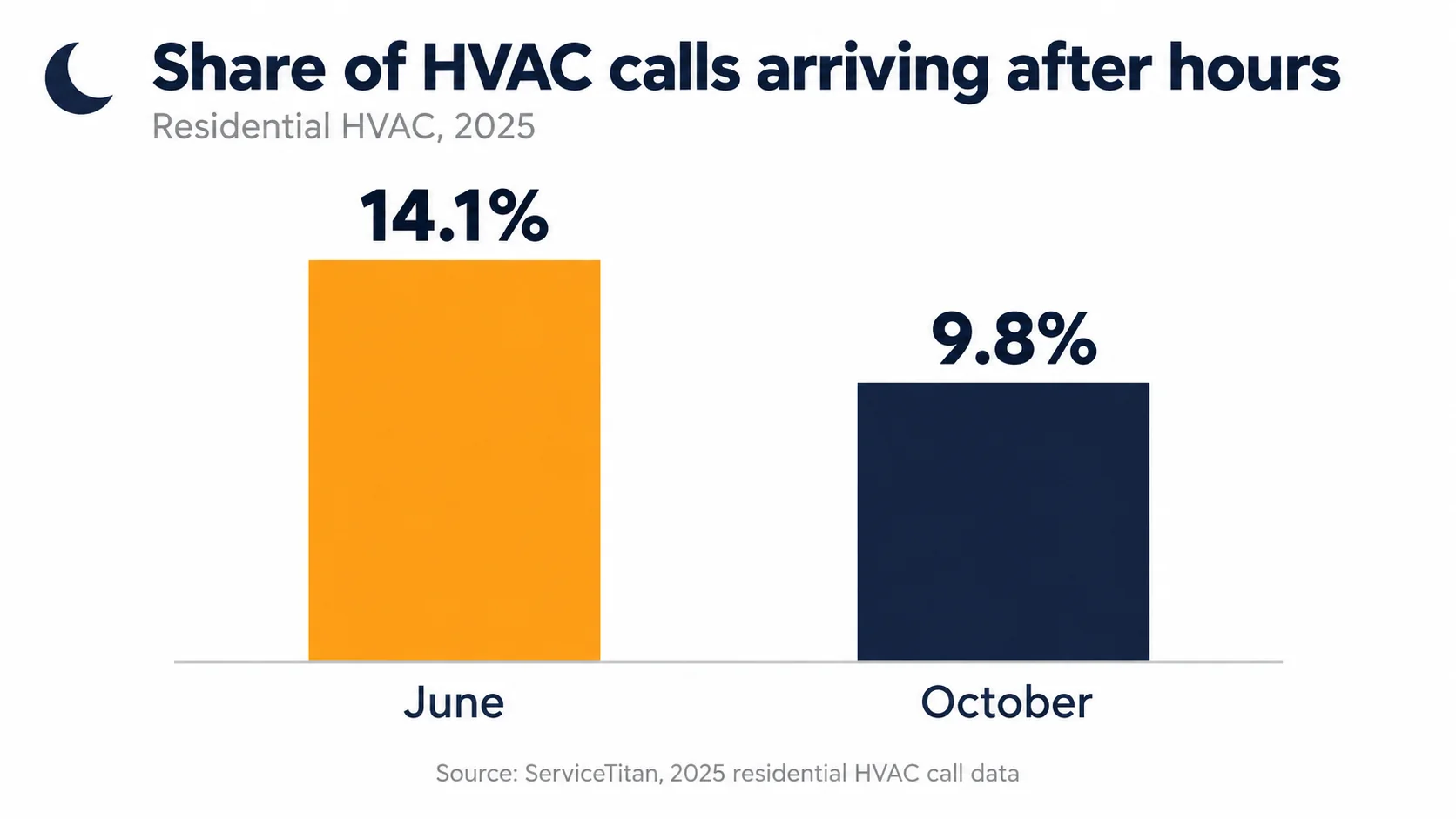
After-hours demand isn't theoretical. ServiceTitan's analysis of 2025 residential HVAC calls found that 14.1% of inbound calls in June arrived outside business hours, compared with 9.8% in October, with weekend call share rising sharply in the summer peak. And Housecall Pro reports that 41% of jobs booked through its online-booking tools are booked after hours. That figure reflects Housecall Pro's own platform rather than the whole industry, but the point holds: homeowners take action when your office is closed.
A replacement customer researching systems at 10:30 on a Sunday night shouldn't need a CSR on duty. But they should be able to do something useful: get preliminary pricing, review equipment options, submit their property details, ask a question, choose an appointment, or request financing information.
Then acknowledge the lead immediately. A website that only works when the office is staffed isn't doing as much work as you think.
Capturing the lead isn't enough if nobody follows up
Sometimes the website actually is producing replacement leads. They're just dying between the website and the office.
The form notification hits an inbox. Somebody's on another call. The dispatcher assumes sales saw it; sales assumes the office called. The homeowner hears back three hours later, and by then they're talking to someone else.
If 20 homeowners submit replacement inquiries and five don't get contacted promptly, you don't have 20 usable leads. You have a process problem that starts after the form fill.
New replacement leads should land somewhere your team can see them and get an immediate acknowledgment. High-intent leads should trigger follow-up. If the homeowner is ready to book, make booking easy. If they aren't ready, keep the lead and stay in touch.
I cover the operational side of this in How to Follow Up With HVAC Leads Faster Without Hiring More CSRs. For the website itself, remember that a confirmation page reading "Thanks! We'll be in touch" isn't the finish line. It's the handoff.
Measure the replacement funnel, not just "website conversions"
If your marketing dashboard says 47 conversions, that doesn't tell you much. Were they phone clicks? Contact forms? Maintenance-plan signups? A call asking whether you sell filters?
For a replacement-focused contractor, I'd want to see each stage separately:
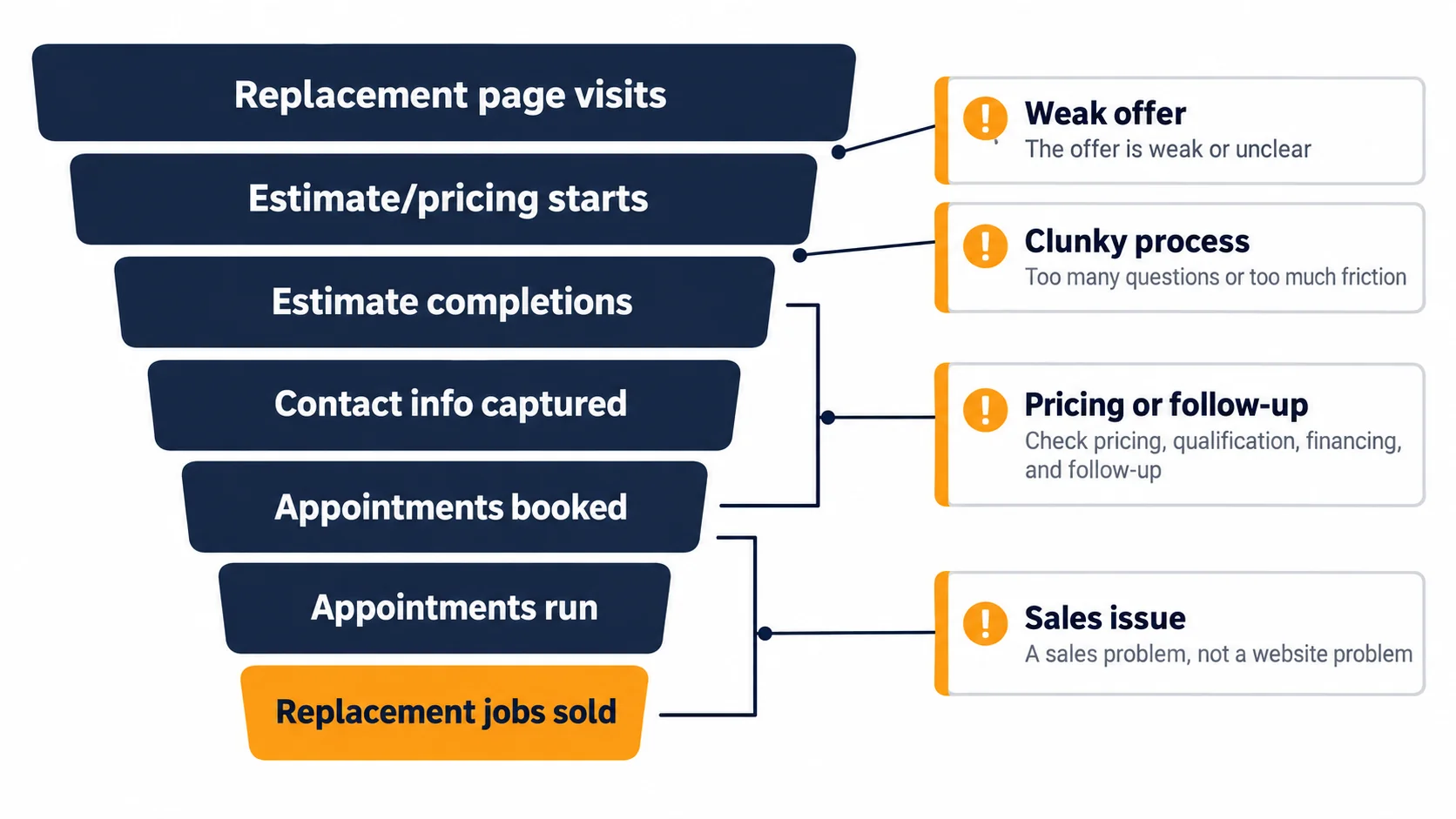
Now you can see where things break:
- Lots of page visits but few estimate starts: the offer is weak or unclear.
- Starts but few completions: you're asking too much or the process is clunky.
- Completions but few bookings: look at pricing, qualification, financing, or follow-up.
- Bookings that don't sell: that's a sales issue, not a website issue.
What's a "good" replacement conversion rate? Be careful with industry benchmarks. Most published HVAC conversion rates blend repair calls, maintenance signups, and replacement inquiries into one number, which makes them close to useless for this question. The more useful benchmark is your own: pull the last 90 days, isolate visitors who landed on replacement pages, and calculate how many became identifiable replacement leads. That's your baseline. Every change in this article should move that number, and you'll know whether it did.
Your website should ultimately be judged by installs, not button clicks.
The bottom line
An HVAC website can rank well, look professional, and still do a lousy job selling replacements.
Contractors understandably focus on traffic because it's easy to see. But if your replacement funnel is weak, buying more traffic just pours more homeowners into the same leak. You already paid to get them there, whether through Google Ads, SEO, LSAs, Angi, or HomeAdvisor.
So fix the buying path first. Tell homeowners what you install. Give them some idea of price. Let them compare options, take the next step when your office is closed, and hear from you quickly when they raise their hand. Then track every lead through to the sold job.
You can do most of that without changing your logo, rebuilding your homepage, or writing another 40 blog posts.
Where Instant Estimate HQ fits
This is the problem Instant Estimate HQ is built around.
Most HVAC websites do a decent job explaining services and a poor job helping a replacement shopper take the next step. Instant Estimate HQ gives that homeowner a dedicated replacement path.
They enter their address and answer a few questions, and the system uses available property information to create preliminary heating and cooling requirements. You control the equipment and pricing shown, and the homeowner receives three good-better-best options instead of a generic "request a quote" confirmation screen. The estimate lives as a branded extension of your website.
After the estimate, the lead, property details, and selected options go into your dashboard or straight into your CRM. Automated text and email follow-up keeps the process moving when someone gets pricing outside office hours.
It won't fix bad traffic, replace a good comfort advisor, or make a weak offer competitive. What it does is give high-intent replacement visitors something more useful to do than fill out a generic form and wait.
If you're already paying to bring replacement shoppers to your website, that's the logical place to start looking for more installs.
Walk through the exact experience your homeowners would get, from entering an address to seeing good-better-best options.
Or book a call to talk through how it would work on your site.
Frequently Asked Questions
Why does my HVAC website get traffic but no replacement leads?
Start by separating a traffic problem from a conversion problem. If most visitors come from repair or informational searches, you may not be attracting enough replacement shoppers. If people are already reaching replacement pages but not contacting you, look at the page itself: Is pricing available? Is there a clear replacement call to action? Can homeowners compare options or act without calling?
What should I put on my HVAC website instead of a "Request a Quote" form?
You don't have to remove the form. Give the homeowner something useful before or alongside it, such as realistic price ranges, good-better-best options, financing information, or a property-specific preliminary estimate. A standard form asks for information. A stronger replacement experience gives information back.
Should HVAC contractors show replacement pricing on their website?
For most replacement-focused contractors, it's worth testing some form of pricing transparency. That doesn't mean publishing one fixed installation price. You can show typical ranges, tiered examples, or preliminary estimates while making clear that final equipment selection and pricing require an in-home evaluation.
How do I capture HVAC leads after hours and on weekends?
Don't make every website action depend on an employee being available. Online estimating, online booking, instant auto-responses, and chat all let a homeowner keep moving. If someone completes an estimate at 10 p.m., your system can acknowledge it immediately and offer a booking option while your staff follows up in the morning.
Can my HVAC website qualify replacement leads before an appointment?
Yes. The site can collect the property address, system age and condition, timing, and homeowner priorities before anyone schedules a visit. If you also show preliminary pricing, homeowners can decide whether to continue after seeing the likely investment, and your comfort advisor arrives with context.
Do I need to rebuild my HVAC website to get more replacement leads?
Not necessarily. You may get better results by adding a dedicated replacement path, clearer calls to action, and an estimate tool to the site you already have. Before paying for a redesign, find out where replacement shoppers are currently dropping out. The problem is often not how the site looks but whether homeowners can get the information they need to take the next step.