Google's Online Estimates Filter: What It Means for HVAC Contractors (and How to Stay Visible)
Instant Estimate HQ
6/3/2026
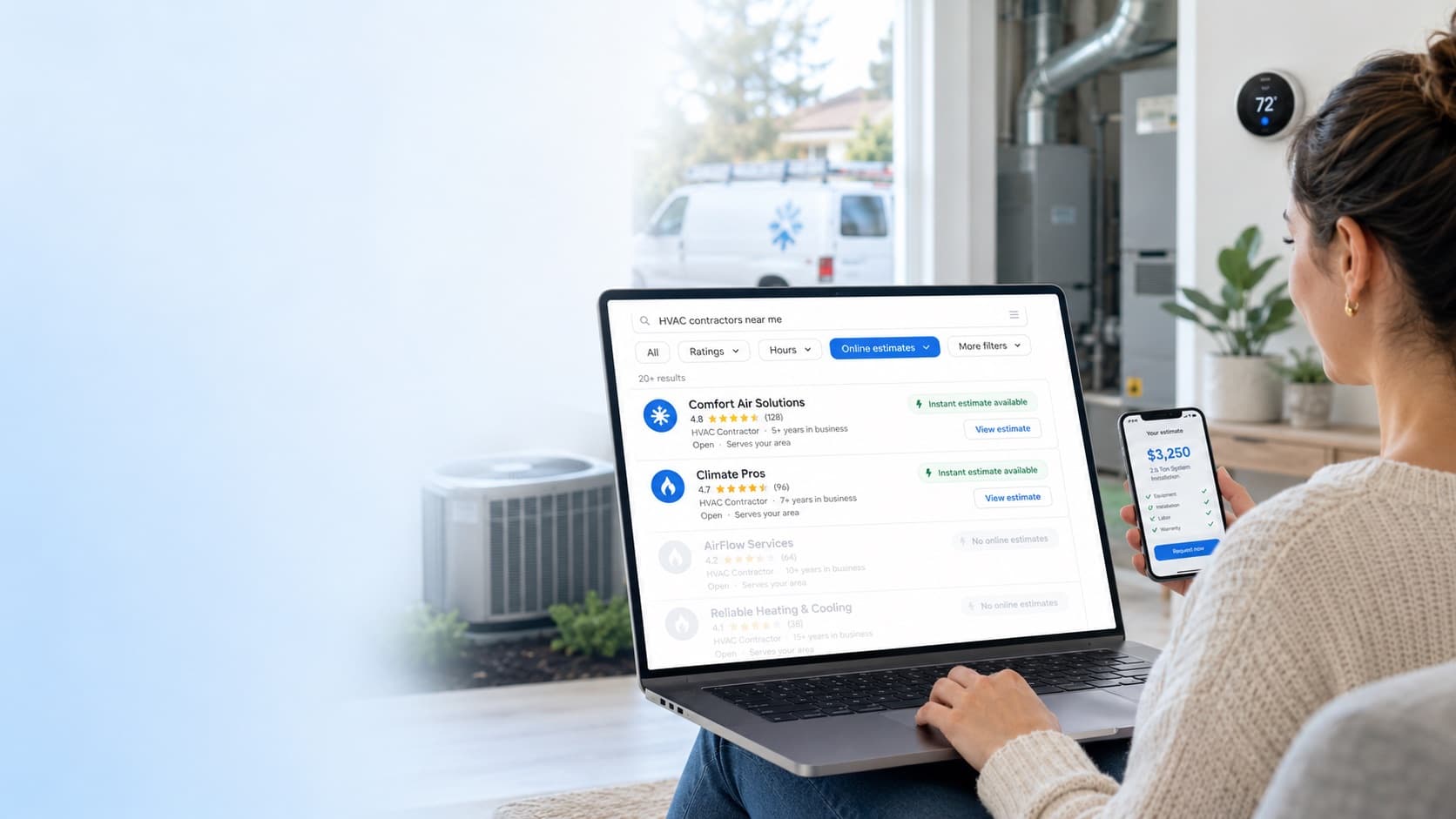
If a homeowner searches "HVAC contractor near me" today, they may see a new button at the very top of their results — above the ads, above the reviews, above the "top-rated" listings. It says Online estimates. One tap, and Google quietly removes every contractor that doesn't appear to offer digital pricing. The Google Online Estimates filter is, in plain terms, a switch that lets a searcher say "only show me businesses that can give me a price online" — and your reviews, proximity, and years of local SEO won't keep you in that filtered view if you're not set up for it.
That's why a growing number of HVAC business owners are suddenly asking whether they're about to disappear from search. This guide walks through what the filter actually is, what we know (and don't know) about how it works, how worried you should really be, and the concrete steps an HVAC contractor can take to stay visible — without overhauling your entire pricing model.
What is the Google Online Estimates filter?
The Google Online Estimates filter is a clickable refinement at the top of local search results that narrows them to businesses offering digital pricing or estimates. It isn't a keyword, an ad, or a traditional ranking factor. It's a toggle — and for searchers who use it, businesses without an online-estimate signal are removed from the results entirely.
A few things make it significant for home-service businesses:
- Placement. It appears at the top of local results for home-service queries, ahead of the review and "top-rated" sections. That gives it outsized influence at the earliest stage of a homeowner's decision.
- It's a filter, not a re-ranking. It doesn't replace Google's usual signals — relevance, proximity, reviews, and authority still matter. It adds a visibility layer on top of them. You can rank perfectly well in normal results and still vanish the moment a user applies the filter, if you lack the online-estimate signal.
- It spans verticals. SEO professionals have observed it across HVAC, roofing, plumbing, solar, windows, and siding searches, with triggering queries like "HVAC contractor near me," "new roof near me," and "plumbers near me."
So the concern isn't that the filter pushes you down a few spots. It's that, for searchers who use it, you can be dropped from the comparison set altogether.
Has Google officially confirmed it?
This is the most important caveat in the entire conversation, and most of the louder takes skip right past it: Google has not officially announced the Online Estimates filter. There's no Google blog post, no help-center documentation, no formal confirmation of how eligibility is determined.
Everything currently "known" about the filter comes from third-party observation — marketing agencies and SEO practitioners noticing it appear across service categories and reverse-engineering how it behaves. It's widely described as in testing or early rollout. That means the mechanics could change, the geographic footprint could shift, or Google could scale it back entirely. (Worth remembering: Google has launched and later killed local features before, including older "Request a Quote" messaging tools.)
Reports on availability are inconsistent — some practitioners describe uneven, region-by-region rollout, and there's disagreement over whether the underlying attribute can even be switched back off once you set it. Treat any geographic or opt-out detail you read as a snapshot, not a permanent rule.
Takeaway: Take the filter seriously and prepare for it — but be skeptical of anyone presenting its mechanics as settled fact. Nobody outside Google has the full rulebook yet.
How the filter decides who shows up
Based on what practitioners have pieced together, two things appear to matter, and both have to be true.
1. The "Online estimates" Google Business Profile attribute
Google Business Profile has carried an "Online estimates" attribute for service businesses for years (you'll find it under Edit profile → More / Attributes). Industry consensus is that enabling this attribute is the baseline eligibility signal for the filter. It's free and takes a couple of minutes — just don't flip it on unless you intend to back it up (more on that next), and note that some contractors report the toggle is sticky once set.
2. A genuine online estimate experience on your site
Here's the part that trips people up. Flipping the attribute on is not enough — and may actually backfire if you fake it. The intent behind the filter is that a homeowner can get real pricing guidance online, fast: not "fill out this form and we'll call you," not a vague "starting at" number, and not "schedule an inspection to get pricing."
Practitioners report that Google appears to watch what happens after the click — if searchers land on your "online estimate" page, find a contact form instead of a price, and immediately bounce back to search, that's a negative signal. In other words, claiming online estimates without delivering them could hurt you more than not claiming them at all.
In our experience building these tools, enabling the attribute without a real estimate page changes nothing — the needle only moves once a homeowner can actually pull a price range on the page itself, not after a callback.
There's also a content angle. An early observation from agency Footbridge Media was that simply featuring "free estimates" language prominently in visible page content helped in some initial tests — suggesting Google may also be scanning page text and structured data for pricing and estimate signals, not just the attribute.
Who wins, who loses — and how worried should you be?
The structural logic is straightforward:
- Winners are contractors with a true online estimator or transparent published pricing. They stay in the filtered view, catch high-intent comparison shoppers, and — proponents argue — get better-informed leads.
- Losers are contractors who rely on "call for a quote," manual estimating, or opaque pricing. Apply the filter, and they can disappear, even with stellar reviews and a long SEO track record.
This is where the dramatic framing comes from. The most-cited early take on the topic — published by an estimate-software vendor and amplified by a viral LinkedIn post — was built around the hook that Google had "wiped out years of home services." The argument: because the filter sits above everything and removes non-participating businesses, it can effectively neutralize the SEO, reviews, and ad spend you've accumulated over years — for that slice of searches.
On scale, the same vendor estimated in an industry webinar that roughly 1 in 4 homeowners are clicking the online-estimate button, and that non-participants could be looking at around a 20% drop in their usual visibility. Promotion for the same event elsewhere phrased adoption as "nearly 1 in 5" homeowners.
A necessary dose of skepticism: almost every impact statistic in this space comes from companies that sell estimate tools or marketing services. The "20% drop" and "1 in 4 / 1 in 5" figures are unaudited vendor estimates — and the fact that the same webinar gets cited with two different adoption numbers is itself a tell that these are ballpark figures, not measured data. A frequently repeated "three out of four homeowners want pricing before committing" stat is attributed to Gartner inside a third-party press release, with no primary Gartner report locatable. None of this means the filter is harmless. It means the honest position is: the structural risk is real, the precise magnitude is unverified, and you should weight the loudest numbers accordingly.
The HVAC-specific reality nobody else is explaining
Most articles on this filter treat all trades the same, which does HVAC contractors a disservice — because HVAC pricing is genuinely harder to estimate online than, say, a standard roof or a window swap.
System-replacement costs swing on home-specific variables: heating and cooling load, electrical readiness, ductwork condition, equipment and efficiency selection, and the homeowner's goals. Proper sizing depends on a Manual J load calculation, which can't be done from a search result. So the instinct to resist publishing a hard price isn't laziness — it's accurate.
The answer is not to post fixed prices, and it's not to refuse online estimates either. It's to provide honest, early-stage orientation:
- Typical system-replacement ranges by home size and system type.
- Plain-language explanations of what pushes cost up or down (efficiency tier, ductwork, electrical, zoning, accessibility).
- Clear framing that an online estimate is preliminary guidance, with final pricing tied to a professional load calculation and in-home evaluation.
Done this way, an online estimate becomes a qualifier, not a liability. It filters out pure price-shoppers before they tie up your phone, and it sends a more informed homeowner into your booking flow. That reframe — online estimates as lead qualification, not lead pricing — is the most useful thing an HVAC owner can take from this whole shift.
How HVAC contractors should respond: a step-by-step plan
Here's a practical sequence, ordered from "do it today, it's free" to "longer-term build."
- Enable the Online estimates attribute in Google Business Profile, and make sure your profile details match your website. Free, fast, low-risk.
- Audit your own listing like a homeowner. Search your service + "near me," apply the filter, click your listing, and try to get a price. If you can't get a range in under two minutes without a forced callback, you've found your problem.
- Publish an HVAC pricing / cost-factors page. Honest ranges by system type and home size, the variables that move the number, and example scenarios at different budget levels. Use natural "online estimate" language near the top.
- Add estimate or schema signals. Implement JSON-LD structured data for your services and pricing so the information is machine-readable — this helps both the filter and the AI features discussed below.
- Build a genuine interactive estimator on a dedicated, navigation-linked page (e.g., "Get an instant estimate"). Inputs like home size and system type should return an immediate range — no forced callback before the number appears.
- Measure lead quality, not just volume. Track conversions and lead quality before and after. If filtered-search visibility or on-site conversion hasn't improved within about 90 days, reassess the tool or vendor — not the strategy.
The bigger picture: Google is betting on instant pricing
The Online Estimates filter isn't a one-off. It's one piece of a clear, accelerating pattern toward instant pricing and self-service convenience in local search.
The clearest companion feature is Google's AI price-checking (surfaced as "Have AI check prices" or "Ask for Me"), where Google's AI calls multiple local businesses on a shopper's behalf, gathers pricing and availability, and emails or texts back a ranked comparison — flagging businesses it "couldn't reach." It's fast: in a documented test, Sterling Sky's Carrie Hill submitted a request at 1:30 PM and had emailed results by 1:41 PM — an 11-minute turnaround — with the AI targeting the top-ranking businesses in the local Map Pack. (Her test was for a haircut, but the feature spans service categories, and one cited study found 48% of answered calls gave the AI no pricing at all — an easy way to land in the "couldn't reach" pile.)
Add AI Overviews and ongoing changes to Local Services Ads, and the direction is unmistakable: Google is rewarding businesses that publish clear, machine-readable pricing and respond instantly, and penalizing those that go dark or make shoppers wait. Most local-search practitioners expect this shift to play out over the next 12 to 24 months — which sounds far off but isn't, given how long a proper estimate experience takes to build well.
Practical implication for HVAC: the missed-call problem is now a visibility problem. Whether it's the AI calling on a homeowner's behalf or the LSA ranking system, not answering increasingly means not appearing. An after-hours answering plan is now part of your local SEO.
Conclusion: prepare, don't panic
Google's Online Estimates filter is a real, well-placed change that can remove HVAC contractors from a homeowner's comparison set in a single click — and it fits a broader, durable trend toward instant, AI-assisted pricing. At the same time, Google hasn't officially documented it, and the scariest numbers attached to it come from companies selling the fix. The honest read: this is worth getting ahead of, calmly and deliberately, not a reason to panic.
The cheapest, smartest first move costs nothing and takes minutes: enable the Online estimates attribute in your Google Business Profile, then search your own service and click through your listing exactly as a homeowner would. If you can't get a real price range without being forced into a callback, that gap is your priority — and an HVAC-appropriate online estimate (preliminary ranges plus clear cost drivers, backed by a proper load calculation) is how you close it while improving lead quality at the same time.
If building that estimate experience from scratch feels like a project, that's exactly what Instant Estimate HQ does — it puts a genuine, filter-ready online estimate on your site, branded as yours. Start a free trial and have a homeowner-ready estimate live this week.
FAQ
What is Google's Online Estimates filter?
It's a clickable filter at the top of local search results that narrows them to businesses offering digital pricing or estimates. It doesn't change your normal ranking — it removes businesses without an online-estimate signal from the filtered view. So you can rank well organically and still vanish the moment a homeowner taps it.
How do I turn on online estimates in Google Business Profile?
Open your profile, go to Edit profile → More / Attributes, and enable the "Online estimates" attribute. It's free and takes a couple of minutes. But the attribute alone isn't enough — back it with a real estimate experience on your site, because faking it can hurt you. Note that some contractors report the toggle is hard to reverse once set, so only enable it if you mean it.
Has Google officially confirmed the Online Estimates filter?
No. There's no Google blog post or help-center page defining the filter or its eligibility rules. Everything known comes from third-party SEO observation, and it's described as in testing or early rollout — so the mechanics could still change.
Does Google hide contractors that don't offer online estimates?
Only for searchers who apply the filter. For them, businesses without an online-estimate signal can be dropped from the results entirely — regardless of reviews or proximity. In normal, unfiltered search, your usual ranking still applies.
Do I have to publish fixed HVAC prices to qualify?
No — and you shouldn't. HVAC pricing depends on load (Manual J), ductwork, and equipment selection, so hard online prices are misleading. Provide honest preliminary ranges by home size and system type, explain what moves the number, and frame final pricing as tied to an in-home evaluation.
What's the difference between the filter and Google's "Have AI check prices"?
The Online Estimates filter is a filter the homeowner applies to surface businesses with online pricing. "Have AI check prices" (also called "Ask for Me") is separate: Google's AI phones local businesses on the homeowner's behalf and emails back a ranked comparison, flagging ones it "couldn't reach." Both reward instant, accessible pricing.
Sources
- Google Business Profile — manage business attributes
- Google Search Help — check pricing for local businesses with AI
- Sterling Sky — "Is Google's AI Calling Your Business?" (Carrie Hill)
Note: Google has not officially confirmed the Online Estimates filter, and the adoption and impact statistics referenced here are vendor estimates rather than audited data. Verify current geographic availability and Google Business Profile settings directly, as this is a fast-moving area.